
NewsMakers
Asthma and allergies more common in teens who stay up late
They found that the chance of having asthma was around three times higher in teens who prefer to sleep later compared to those who preferred to sleep earlier. They also found the risk of suffering allergic rhinitis was twice as high in late-sleepers compared to early-sleepers.


Teenagers who prefer to stay up late and wake later in the morning are more likely to suffer with asthma and allergies compared to those who sleep and wake earlier, according to a study published in ERJ Open Research.
Asthma symptoms are known to be strongly linked to the body’s internal clock, but this is the first study to look at how individual sleep preferences influence asthma risk in teenagers.
Researchers say the study reinforces the importance of sleep timing for teenagers and opens up a new channel of research in to how sleep affects teenagers’ respiratory health.
The study was led by Dr. Subhabrata Moitra from the division of pulmonary medicine at the University of Alberta, Canada, who carried out the research while at the Barcelona Institute for Global Health, Spain. He said: “Asthma and allergic diseases are common in children and adolescents across the world and the prevalence is increasing. We know some of the reasons for this increase, such as exposure to pollution and tobacco smoke, but we still need to find out more.
“Sleep and the ‘sleep hormone’ melatonin are known to influence asthma, so we wanted to see if adolescents’ preference for staying up late or going to bed early could be involved in their asthma risk.”
The study involved 1,684 adolescents living in West Bengal, India, aged 13 or 14 years, who were taking part in the Prevalence and Risk Factors of Asthma and Allergy-Related Diseases among Adolescents (PERFORMANCE) study.
Each participant was asked about any wheezing, asthma, or symptoms of allergic rhinitis, such as a runny nose and sneezing. They were asked a series of questions to judge whether they were ‘evening types’, ‘morning types’ or in between, such as what time of the evening or night they tend to feel tired, when they would choose to wake up, and how tired they feel first thing in the morning.
Researchers compared the teenagers’ symptoms with their sleep preferences, taking into account other factors that are known to affects asthma and allergies, such as where the participants live and whether their family members smoke.
They found that the chance of having asthma was around three times higher in teens who prefer to sleep later compared to those who preferred to sleep earlier. They also found the risk of suffering allergic rhinitis was twice as high in late-sleepers compared to early-sleepers.
Moitra adds: “Our results suggest there’s a link between preferred sleep time, and asthma and allergies in teenagers. We can’t be certain that staying up late is causing asthma, but we know that the sleep hormone melatonin is often out of sync in late-sleepers and that could, in turn, be influencing teenagers allergic response.
“We also know that children and young people are increasingly exposed to the light from mobile phone, tablets, and other devices, and staying up later at night. It could be that encouraging teenagers to put down their devices and get to bed a little earlier would help decrease the risk of asthma and allergies. That’s something that we need to study more.”
A second phase of the PERFORMANCE study is scheduled in 2028-29, which means it will be possible to repeat the study with a new group of teenagers to see if there has been any change in teenagers sleeping habits and their respiratory health. Dr Moitra and his team also hope to quantify their findings by taking objective measurements of participants’ lung function and sleep time.
Professor Thierry Troosters is President of the European Respiratory Society and was not involved in the research. He said: “We need to know much more about why asthma and allergies are rising in children and teenager and, hopefully, find ways to reduce these conditions.
“This is the first study to examine the possible role of different sleep preferences in teenagers’ risk of asthma and allergies, and it opens up an interesting and important new line of research. We already know that sleeping well is important for physical and mental health, so we should continue to encourage teenagers to get a good night’s sleep.”




NewsMakers
Scheduling dental care during prenatal visits boosts oral health care during pregnancy
Scheduling a dental appointment during prenatal clinic visits—a simple, no-cost task that doesn’t require extra staff—increases the likelihood that patients later see a dentist during pregnancy.

Prenatal visits might include bloodwork, discussions of due dates and vitamins, and ultrasounds. What if these visits could also improve oral health care among pregnant patients?
New research shows that scheduling a dental appointment during prenatal clinic visits—a simple, no-cost task that doesn’t require extra staff—increases the likelihood that patients later see a dentist during pregnancy.
The study, published in the American Journal of Public Health, demonstrates the benefit of coordination among health providers and integrating oral health into prenatal care, especially for vulnerable patient populations.
Historically, dentists avoided treating women during pregnancy unless it was an emergency, or only provided care during the second trimester. This guidance changed once studies showed that routine and emergency dental care is safe during pregnancy—and current obstetric and dental guidelines stress that dental care can and should be provided during this critical period.
Moreover, pregnancy increases the risk of some oral health conditions, including gum inflammation and sometimes tooth decay, making routine dental care even more important during pregnancy. Some oral health issues may affect the fetus or even be transmissible to the child after birth.
Marginalized groups, including low-income individuals and those insured by Medicaid, are known to have higher rates of dental disease. Yet women enrolled in Medicaid are far less likely to see a dentist for a cleaning during pregnancy compared to women with private insurance.
“Many of those vulnerable to oral disease enter pregnancy with dental disease, and this may worsen during pregnancy,” said study author Stefanie Russell, associate professor at Rutgers School of Dental Medicine and an adjunct associate professor at NYU College of Dentistry, who led this research while at NYU.
One way to try and increase dental care among pregnant women is to reach them where they already are: their prenatal appointments. To bridge this gap, researchers and clinicians at NYU College of Dentistry teamed up with neighboring NYC Health + Hospitals/Bellevue, the oldest public hospital in the US, to create the New York University/Bellevue Prenatal Oral Health Program.
During weekly sessions at Bellevue’s prenatal clinic, pregnant patients receive a standardized screening to assess their oral health. Those with dental needs are referred to NYU College of Dentistry for follow-up care, educated about the importance and safety of dental care during pregnancy, and informed that Medicaid covers dental care in New York.
From 2018 to 2020, 420 prenatal patients with Medicaid coverage were referred to NYU Dentistry for follow-up dental care; the majority were Hispanic, and roughly half spoke Spanish as their first language. Referrals for dental care took two forms: immediately scheduled dental appointments made before the patient left the prenatal clinic or through a patient navigator. The patient navigator—a bilingual professional—educated patients regarding oral health, reminded patients of their upcoming dental appointments, and followed up after to identify any issues.
Nearly 44 percent of patients referred to NYU College of Dentistry followed through with a dental appointment. Both immediate appointment scheduling and the patient navigator increased the chances of a patient receiving dental care, but those who had appointments scheduled at their prenatal visit were 2.6 times more likely to see a dentist than those without appointments scheduled—even more likely than those who worked with the patient navigator.
“This suggests that immediately scheduled dental appointments can be an effective way to increase dental care utilization during pregnancy, without needing to hire extra staff,” said study author Shulamite Huang, assistant professor of epidemiology and health promotion at NYU College of Dentistry.
The authors conclude that integrating oral health screening in a prenatal clinic is feasible and increases engagement with dental care during pregnancy. They are continuing their research to measure whether this care improves oral health outcomes and to better understand how dental screening can be successfully integrated with prenatal care in other settings.
“A warm hand-off is key for addressing part of the barriers to dental care during pregnancy. Our team plans to further investigate and optimize interventions addressing both patient-, provider-, and healthcare system-level barriers to dental care during pregnancy,” said Huang.
Additional study authors include Richard Heyman and Mary Kang of NYU Dentistry; Belkys Saba, formerly of NYU Dentistry; Chloe Bird of the Tufts University School of Medicine; and Chengwu Yang of the Florida Atlantic University Schmidt College of Medicine.
NewsMakers
Why a UTI hurts — and why that might be a good thing
Australian researchers have discovered a previously overlooked group of bladder nerves that help detect urinary tract infections (UTIs) and trigger the body’s response to clear them, providing a potential new target for future bladder pain therapies.
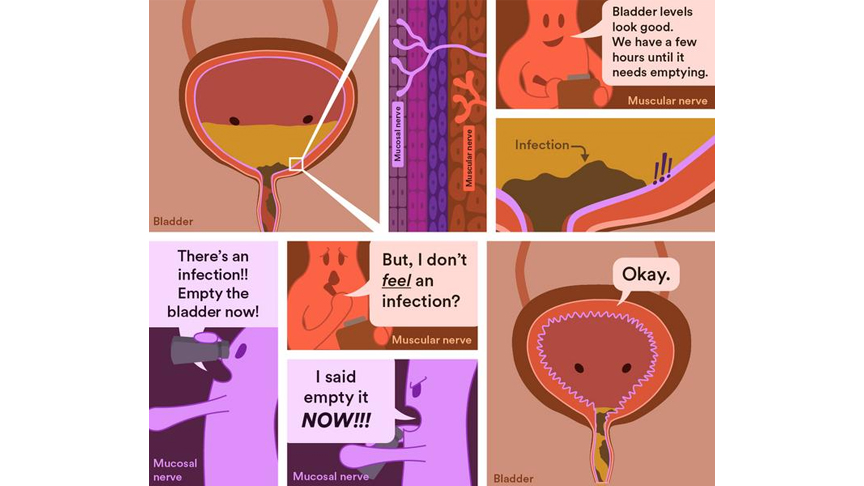
Australian researchers have discovered a previously overlooked group of bladder nerves that help detect urinary tract infections (UTIs) and trigger the body’s response to clear them, providing a potential new target for future bladder pain therapies.
The study shows that bladder nerves located close to the lining of the bladder act as a frontline infection sensor, helping the body recognise UTIs and trigger responses that reduce the severity and spread of infection.
UTIs are among the most common bacterial infections worldwide, with more than 400 million cases reported every year. Nearly one in three women will experience UTIs before the age of 24, and many elderly people and those with bladder issues from spinal cord injuries can experience multiple UTIs in a single year.
Symptoms often include frequent urination, a sudden urge to urinate, pain during urination, and pelvic discomfort can be debilitating for some patients.
Flinders University’s Dr Luke Grundy says that while scientists have long understood how the bladder senses as it fills and triggers urination, the role of a specialised group of bladder nerves near the bladder lining has remained unclear.
“Most bladder nerves act like a fuel gauge, telling the brain when the bladder is filling up and needs emptying,” says Dr Grundy, Head of the NeuroUrology Research Group at Flinders University.
“The nerves we studied in this research are different. They sit close to the bladder lining and appear to act more like an early warning system, detecting infection and inflammation.
“They don’t just sense infection. They help coordinate the body’s response to it by triggering pain and urinary frequency, behaviours that appear to help clear bacteria from the bladder as part of the body’s defence system.”
Lead author and recently graduated PhD student Dr Cindy Tay says the discovery changes how these nerves are understood.
“These mucosal nerves have puzzled scientists for almost two decades because they stay quiet while the bladder fills and empties, which is the main job of the bladder,” says Dr Tay.
“What we’ve found is that they have a hidden job — acting as an early warning system that springs into action the moment infection takes hold.”
The research team developed a novel method to selectively study a specialised group of sensory nerves in the bladder lining of mice, revealing that while these nerves play little role in normal bladder function, they become highly responsive during a UTI and help detect and respond to infection.
“When the bladder is healthy, these nerves are relatively quiet, but during a urinary tract infection they become highly sensitive and respond to the presence of bacteria and inflammation,” says Dr Grundy.
“It may feel unpleasant, but urinating more frequently actually helps clear the infection by flushing out the harmful bacteria.”
The study also helps explain why people with conditions affecting nerve function may be more prone to recurrent or severe UTIs.
“If the nerves that detect infection aren’t working properly, the body may not respond as effectively,” says Dr Grundy.
Building on previous research, the new study reveals a deeper understanding of how UTIs affect bladder function and the nervous system, and could help develop new treatments that target these nerves to relieve UTI-related symptoms.
“Our findings provide new insight into how the bladder detects and responds to infection, helping explain the biological processes that drive the pain, urgency and discomfort commonly experienced during UTIs,” says Dr Grundy
Researchers say the next challenge is to develop therapies that ease the pain and urgency associated with UTIs while preserving the protective role these nerves play in fighting infection.
The paper, ‘Bladder mucosal afferents detect UTI and aid pathogen clearance,’ by Cindy Tay, Harman Sharma, Stewart Ramsay (University of Adelaide), Georgia Bourlotos, Sarah K Manning, Natalie E Stevens, Sophie J Miller, Geraint B Rogers, David J Lynn, Feargal J Ryan, Andrea M Harrington (University of Adelaide), Vladimir Zagorodnyuk, Steven L Taylor and Luke Grundy was published in Proceedings of the National Academy of Sciences (PNAS).
NewsMakers
Pregnancy complications can signal heart disease risk years before traditional screening, study finds
Some women, particularly younger women often considered low risk, may face a higher risk of heart disease earlier than previously recognized.

McGill University researchers have developed a new tool to identify heart disease risk in women earlier in life.
Findings from a study published in JACC: Advances highlight gaps in existing approaches.
“Heart disease is the leading cause of death in women, yet existing risk tools were developed in older populations and ignore factors unique to women,” said senior author Robert Platt, Professor in the Department of Epidemiology, Biostatistics, and Occupational Health and Director of the School of Population and Global Health.
While pregnancy complications are known to be linked to future heart risk, there has been no way to identify which younger women are most at risk, he added.
Detecting risk earlier
Using health data from more than 260,000 women in the UK aged 15 to 45 who had given birth, researchers developed and validated a prediction model to estimate future heart disease risk. Participants were followed for nearly four years after delivery.
The model identified several factors – not included in existing tools – that can help predict risk, including hypertensive disorders of pregnancy, gestational diabetes, preterm birth, PCOS, depression, thyroid disorders, oral contraceptive use and social deprivation.
The findings suggest some women, particularly younger women often considered low risk, may face a higher risk of heart disease earlier than previously recognized.
“Millions of women who give birth each year are never considered candidates for cardiovascular risk assessment simply because of their age,” said co-author Kristian Filion, Professor in the Departments of Medicine and of Epidemiology, Biostatistics, and Occupational Health.
If integrated into routine postpartum care, this tool could enable earlier monitoring, lifestyle counselling or referral to a specialist, potentially helping prevent a heart attack or stroke later in life, he added.
The next step is to validate the model in Canada and the United States. In the longer term, the goal is to integrate a practical calculator into electronic health records so higher-risk patients can be identified earlier.
About the study
“Development and Validation of a Prediction Model for Cardiovascular Risk in Reproductive-Aged Women” by Sonia Grandi, Kristian Filion, Jennifer Hutcheon, Graeme Smith, and Robert Platt was published in JACC: Advances. The study was supported by the Canadian Institutes of Health Research.

Manulife Investments Philippines leads UITF rankings across equity and fixed income funds

Scheduling dental care during prenatal visits boosts oral health care during pregnancy

Enjoying the grilling at Mandaue City’s Matias BBQ

Dogs can distinguish between human fear and sadness

Pet dog microbiota may protect young children from respiratory tract infections and reduce the need for antibiotic courses

Walking and weight training alone are not enough for strong bones – football and handball may be more effective

Keeping kitty indoors is not the cat-astrophe that owners fear

Why a UTI hurts — and why that might be a good thing

Pregnancy complications can signal heart disease risk years before traditional screening, study finds

Posture can influence your mood and behavior, study suggests

Filipinos prioritize independence as legacy for longer lives

Loneliness strongly linked to poorer mental health and wellbeing, study finds

Weight loss drugs could help with binge eating disorder

Coffee and heart health: How many cups of caffeinated coffee are safe to drink each day?

Going Chinese in Pulilan, Bulacan

Eating out in Cebu in one place via Pusô Village
Pregnancy complications can signal heart disease risk years before traditional screening, study finds
Posture can influence your mood and behavior, study suggests
Why a UTI hurts — and why that might be a good thing
Walking and weight training alone are not enough for strong bones – football and handball may be more effective

-
 NewsMakers2 weeks ago
Filipinos prioritize independence as legacy for longer lives
-
 NewsMakers4 weeks ago
Loneliness strongly linked to poorer mental health and wellbeing, study finds
-
 NewsMakers4 weeks ago
Weight loss drugs could help with binge eating disorder
-
 NewsMakers3 weeks ago
Coffee and heart health: How many cups of caffeinated coffee are safe to drink each day?
-
 Destinations3 weeks ago
Going Chinese in Pulilan, Bulacan
-
 Destinations2 weeks ago
Eating out in Cebu in one place via Pusô Village
-
 NewsMakers2 weeks ago
Pregnancy complications can signal heart disease risk years before traditional screening, study finds
-
 NewsMakers2 weeks ago
Posture can influence your mood and behavior, study suggests