
NewsMakers
Study finds rare, but influential, genetic changes related to height
In the largest, deepest search to date, the international Genetic Investigation of Anthropometric Traits (GIANT) Consortium has uncovered 83 new DNA changes that affect human height. These changes are uncommon or rare, but they have potent effects, with some of them adjusting height by more than 2 cm (almost 8/10 of an inch).

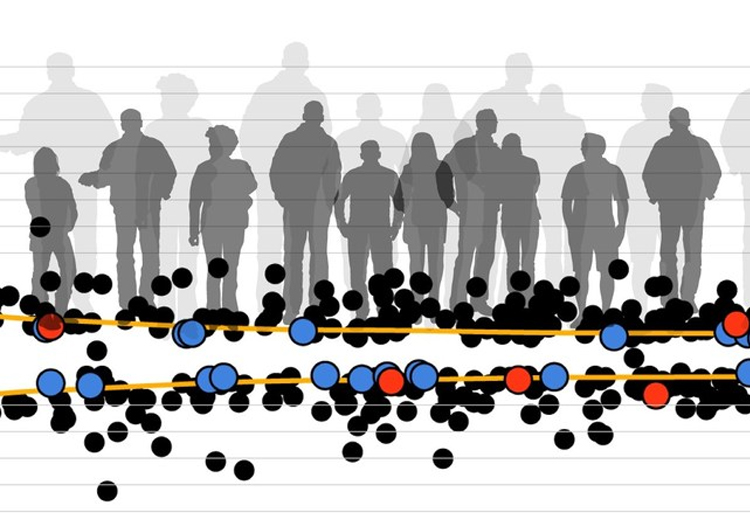
In the largest, deepest search to date, the international Genetic Investigation of Anthropometric Traits (GIANT) Consortium has uncovered 83 new DNA changes that affect human height. These changes are uncommon or rare, but they have potent effects, with some of them adjusting height by more than 2 cm (almost 8/10 of an inch). The 700,000-plus-person study also found several genes pointing to previously unknown biological pathways involved in skeletal growth. Findings were published online by Nature.
“While our last study identified common height-related changes in the genome, this time we went for low-frequency and rare changes that directly alter proteins and tend to have stronger effects,” says Joel Hirschhorn, MD, PhD, of Boston Children’s Hospital and the Broad Institute of MIT and Harvard, chair of the GIANT Consortium and co-senior investigator on the study together with researchers at the Montreal Heart Institute, Queen Mary University, the University of Exeter, UK, and nearly 280 other research groups. “To identify these protein-altering changes, some of them very uncommon, required tremendous statistical power, which we achieved thanks to a strong international collaboration.”
Applying a new technology
In 2014, GIANT, studying roughly 250,000 people, brought the total number of known genetic variants to nearly 700 — in more than 400 spots in the genome. This effort involved a powerful method called genome-wide association study (GWAS), which rapidly scans across the genomes of large populations for markers that track with a particular trait. GWAS are good at finding common genetic variants, but nearly all of the identified variants alter height by less than 1 mm (less than 1/20 of an inch). GWAS studies are not as good at capturing uncommon genetic variants, which can have larger effects. Finally, the common variants that track with traits tend to lie mostly outside the protein-coding parts of genes, making it harder to figure out which genes they affect.
So in the new study, the GIANT investigators used a different technology: the ExomeChip, which tested for a catalogue of nearly 200,000 known variants that are less common and that alter the function of protein-coding genes. These variants point more directly to genes and can be used as a shortcut to figuring out which genes are important for a specific disease or trait. Most had not been assessed in prior genetic studies of height.
Using ExomeChip data from a total of 711,428 adults (an initial 460,000 people and about 250,000 more to validate the findings), the investigators identified 83 uncommon variants associated with adult height: 51 “low-frequency” variants (found in less than 5 percent of people) and 32 rare variants (found in less than 0.5 percent).
With these new findings, 27.4 percent of the heritability of height is now accounted for (up from 20 percent in earlier studies), with most heritability still explained by common variants.
Twenty-four of the newly discovered variants affect height by more than 1 cm (4/10 of an inch), larger effects than typically seen with common variants. “This finding matches a pattern seen in other genetic studies, where the more potent variants are rarer in the population,” says Hirschhorn, who is also an endocrinologist at Boston Children’s and a professor of pediatrics and genetics at Harvard Medical School.
Rare but potent clues to new biology
These rare variants not only had large effects but also pointed to dozens of genes as important for skeletal growth. Some of these genes were already known, but many (including SUSD5, GLT8D2, LOXL4, FIBIN, and SFRP4) have not previously been connected with skeletal growth.
One gene of particular interest, STC2, had two different DNA changes that both had larger effects on height. Though the variants are quite rare (frequency of 0.1 percent), people with either of these changes were 1-2 cm taller than non-carriers. Further investigations by co-authors Troels R. Kjaer and Claus Oxvig of Aarhus University (Denmark) suggested that the variants influence height by affecting the availability of growth factors in the blood. “The STC2 protein serves as a brake on human height, validating it as a potential drug target for short stature,” says Hirschhorn.
Height: A window into complex genetics
Why study height? Height is the “poster child” of complex genetic traits, meaning it is influenced by multiple genetic variants working together. It’s easy to measure, so makes a relatively simple model for understanding traits produced by not one gene, but many.
“Mastering the complex genetics of height may give us a blueprint for studying multifactorial disorders that have eluded our complete understanding, such as diabetes and heart disease,” says Hirschhorn. “This study has shown that rare protein-altering variants can be helpful at finding some of the important genes, but also that even larger sample sizes will be needed to completely understand the genetic and biologic basis of human growth and other multifactorial diseases.”
Indeed, the GIANT consortium is already embarking on a GWAS of height with more than 2 million people, and other studies involving sequencing data are underway. “We predict that these more comprehensive studies will continue to enhance our understanding of human growth and how best to attain the biological insights that will inform treatments for common diseases,” says Hirschhorn.
In addition to Hirschhorn, the study’s co-senior authors include Timothy Frayling of the University of Exeter, Panos Deloukas of the Queen Mary University of London and Guillaume Lettre of the University of Montreal. Co-first authors were Eirini Marouli of Queen Mary University; Mariaelisa Graff of the University of North Carolina, Chapel Hill; Carolina Medina-Gomez of Erasmus Medical Center (Rotterdam, Netherlands); Ken Sin Lo of the Montreal Heart Institute; Andrew R Wood of the University of Exeter (U.K.), Troels R. Kjaer of Aarhus University (Denmark), Rebecca S. Fine of the Broad Institute, Boston Children’s Hospital and Harvard Medical School; and Yingchang Lu of Vanderbilt University (Nashville, TN) and the Icahn School of Medicine at Mount Sinai (New York). The study’s numerous funding sources include the National Institutes of Health, the Wellcome Trust, MRC, the European Research Council, the European Union, the Canadian Government, the Canadian Institutes of Health Research, the Danish Council, Novo Nordisk and the Lundbeck Foundation.







Beauty & Fashion
Redefining aesthetics: From anti-aging to healthy aging
Growing attention is now being given to healthy aging, understanding how the entire face changes over time, preserving facial harmony, and helping people continue to look like themselves.


For decades, “anti-aging” has defined the beauty and aesthetics conversation, promising to erase wrinkles and reverse the signs of time. Today, that conversation is shifting.
Aging is no longer just about looking younger. Growing attention is now being given to healthy aging, understanding how the entire face changes over time, preserving facial harmony, and helping people continue to look like themselves.
A review published in Facial Plastic Surgery, The Anatomy of the Aging Face: A Review, describes aging as changes across bone, ligaments, muscles, fat, and skin. Another review in Aesthetic Surgery Journal, The Facial Aging Process From the “Inside Out”, explains how changes beneath the surface eventually become visible on top.
Studies in Plastic and Reconstructive Surgery show facial fat is organized into distinct anatomical compartments that can lose volume and shift position over time, altering facial shape and balance.
For multi-awarded aesthetic physician Dr. James Co, founder of Cosma Institute and Architect of Aesthetic Confidence, these findings are the reason aesthetic care must start with understanding, not just treating.
“Aging is not a disease we need to cure,” Co said. “It is a biological process. As physicians, our role is to understand what is changing beneath the surface, how those changes differ from person to person, and whether intervention is appropriate in the first place.”
“When you only look at the wrinkle, you are looking at the surface of a much bigger anatomical process,” he added. “The face ages as a system. Good assessment means understanding what is happening underneath before deciding what should be done on the surface.”
Part of that understanding is recognizing that no two faces age the same way. Two people can be the same age and experience aging very differently. Genetics, skeletal structure, fat distribution, skin characteristics, sun exposure, lifestyle, and environmental factors all influence how aging presents.
“Two patients can be the same age and come to me with completely different anatomy, lifestyles, concerns, and goals,” Co said. “Why would we expect their treatment plans to look exactly the same?”
This is where healthy aging broadens the conversation — from fixing isolated signs to looking at the face as a whole and listening to what the individual actually wants.
“Someone can want to look refreshed without wanting to look 20 years younger,” Co said. “Those are completely different goals.”
Rather than trying to freeze one version of the face forever, healthy aging acknowledges that the face will continue to change. As different structures change at different rates, the relationship between features evolves. Facial harmony is therefore not fixed.
“You cannot freeze one version of your face forever,” Co said. “But you can understand how the face is changing and make decisions that respect its natural proportions and your identity.”
In the age of social media, where aesthetic treatments are highly visible, Co cautions against self-diagnosis.
“Patients should not have to diagnose themselves from social media,” he said. “You might recognize a concern, but deciding why it is happening and what should be done about it requires proper assessment.”
The shift is also about how people feel, not just how they look. A 2022 review on minimally invasive facial aesthetic procedures found studies are increasingly looking beyond physical changes to include satisfaction with appearance and aspects of psychological and social well-being, while noting that evidence still needs careful interpretation.
For Co, this reinforces that success is not always about looking dramatically younger.
“We need to ask whether the result makes sense for the patient, whether expectations were met, and whether we preserved the things that make that person recognizable,” he said. “I would rather someone tell my patient, ‘You look well,’ than immediately ask, ‘What did you have done?'”
At Cosma Institute, Co applies this consultation-led philosophy through individualized assessment, facial harmony, medical judgment, and patient education. Having trained aesthetic practitioners across Southeast Asia and Europe, he advocates for natural-looking outcomes that respect the characteristics already present in each face — an approach that recently earned him two awards at the Merz Aesthetics Tala Awards.
For Co, the evolution of aesthetic medicine is not about having more tools, but knowing when to use them — and when not to.
“Aging cannot be stopped, and I don’t think that should be the promise,” he said. “What we can do is understand it better. We can look at the science, understand the anatomy, listen to the patient, and make decisions that allow them to age while still looking recognizably like themselves.”
For Co, healthy aging begins not with fighting age, but with understanding it.
NewsMakers
The look and feel of your neighborhood may affect your sleep
Those living in neighborhoods rated as having a stronger sense of safety tended to sleep longer, and that this rating appeared to be shaped by the streetscape.

Your neighborhood’s “streetscape”—the physical environment of your street—is something that you have probably never consciously thought about, despite seeing it every day. But what if the streetscape was affecting you on a subconscious level and disrupting your sleep?
This intriguing question is posed by the findings of a study led by Professor Daisuke Matsushita of the Graduate School of Human Life and Ecology at Osaka Metropolitan University. The research team used AI to analyze more than 200,000 Google Street View images to identify visual neighborhood characteristics. They then linked these characteristics to the self-reported sleep of 1,089 working adults living on the lower floors of apartments in Tokyo, who were most likely to be affected by the streetscape.
They found that those living in neighborhoods rated as having a stronger sense of safety tended to sleep longer, and that this rating appeared to be shaped by the streetscape. Generally, people slept longer in areas with lots of greenery, such as leafy trees, on the street. Similarly, high “enclosure”—meaning many tall vertical buildings and few wide-open spaces—was also associated with longer sleep and fewer insomnia symptoms.
However, the study also made a surprising finding. The researchers found that highly walkable streetscapes, such as those with more sidewalks and traffic signs, were associated with a lowered sense of safety and shortened sleep duration.
This suggests that walkability does not always represent a reassuring environment. Instead, a possible explanation is that streets with extensive pedestrian infrastructure are often busier, more crowded, and used by more strangers, which may be perceived as less safe or less relaxing than quieter residential streets.
“This study demonstrates the potential for evaluating streetscape characteristics across large geographic areas in a cost-effective manner,” Dr. Matsushita said. “Based on the technique used in this study, cities could potentially measure perceived safety, beauty, liveliness, and enclosure as well as pollution and noise.”
“We hope that opening up this new perspective creates further possibilities for designing healthier neighborhoods,” he concludes.
The findings were published in Building and Environment.
NewsMakers
Workout or nap? Either can help your sleepless brain, study finds
People who either completed 20 minutes of moderate-to-vigorous exercise or took a 90-minute nap performed about 22 per cent better on memory tests after 30 hours without sleep than those who did neither.

A short workout or a nap can help protect memory after a sleepless night, a McGill University-led study has found.
Researchers found people who either completed 20 minutes of moderate-to-vigorous exercise or took a 90-minute nap performed about 22 per cent better on memory tests after 30 hours without sleep than those who did neither. The findings, published in Proceedings of the National Academy of Sciences (PNAS), point to practical ways to counter the effects of sleep deprivation.
“Sleep loss affects nearly every aspect of how we think and function, but many people can’t simply stop what they’re doing and get more sleep,” said senior author Marc Roig, Professor in McGill’s School of Physical and Occupational Therapy. “Our findings show that even a brief bout of exercise may help preserve one of our most important cognitive abilities.”
The study involved 54 healthy young adults who stayed awake for 30 consecutive hours under lab supervision. Participants were then assigned to one of three groups: a 20-minute cycling session, a 90-minute nap or a control condition. Three days later, researchers tested their memory for images they had viewed immediately after the intervention. Those who exercised or napped remembered significantly more images than participants who did neither.
Same result, different pathways
While the memory benefits were nearly identical, brain recordings revealed that exercise and napping helped in different ways.
Napping appeared to help the brain recharge, making it easier to take in and remember new information. Exercise, by contrast, helped the brain use its remaining resources more efficiently, without making participants feel more tired.
The findings could eventually inform fatigue-management strategies in workplaces where sleep loss is common and mistakes can have serious consequences, such as health care, transportation and emergency response.
“A nap isn’t always possible in the middle of a shift,” said first author Madhura Lotlikar, a doctoral candidate in McGill’s Department of Neurology and Neurosurgery. “Exercise is accessible, inexpensive and easy to implement. That makes it a promising tool to help people stay cognitively sharp when sleep is limited.”
The researchers emphasize that exercise cannot replace sleep, but it may help people function better when getting enough rest isn’t possible.
About the study
“Protecting episodic memory after sleep loss: Similar benefits of exercise and naps via distinct neural contributions” by Madhura Lotlikar and Marc Roig et al., was published in Proceedings of the National Academy of Sciences of the United States of America.

Men’s health expert issues warning to fans copying Mark Wahlberg’s early starts

Manulife broadens financial literacy, clean water programs in PH

Redefining aesthetics: From anti-aging to healthy aging

Visiting San Pablo City’s Pho Viet Nam

Four to six servings of wholegrain per day lowers risk factors for heart disease

Structured exercise linked to longer cancer survival and time free of disease

Heading to Pila, Laguna? Check out La Cosina Antonio

Pasalubong shopping in Davao via Aldevinco

The look and feel of your neighborhood may affect your sleep

Workout or nap? Either can help your sleepless brain, study finds
Redefining aesthetics: From anti-aging to healthy aging
Manulife broadens financial literacy, clean water programs in PH
Men’s health expert issues warning to fans copying Mark Wahlberg’s early starts

