
Destinations
Discover the Boracay of CARAGA
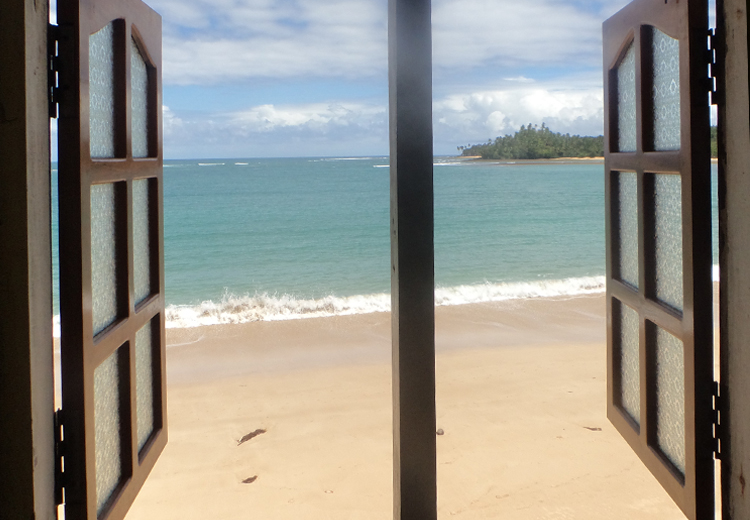
When he discovered Cagwait White Beach, dubbed as the “Little Boracay of CARAGA”, John Ryan Mendoza said he automatically expected to feel the powder-like consistency of Boracay’s sands. But he was dismayed. Here, the sand is… coarser. But the initial dismay was overshadowed by the fact that Cagwait offers what Boracay couldn’t: serene isolation.

 After our whole day habal-habal adventure to the Tinuy-an Falls and Enchanted River, we all felt that we needed a lazy day at an isolated beach.
“Cagwait White Beach!” exclaimed our friend, a local of Bislig.
It was off-peak season and she said we would be treated to a tranquil stay at the “Little Boracay of CARAGA.”
 And so we took the early morning bus from Bislig and got off at the town of Barobo. At the Barobo bus terminal, we took the 85 peso van ride to Cagwait, a fourth class municipality of Surigao del Sur; and which faces Mount Diwata on the west and the coast of the Pacific Ocean in the east. It is approximately 32 kilometers southwest of Tandag, the capital town of the province.
Locals in the area say that a young traveler who escaped the Spaniards in Leyte saw this horseshoe shaped white sand beach. “Mura og wait,” he was said to have mentioned, likening the beach to that of the human mouth; thus the name, Cagwait.
Cagwait White Beach is also the venue for the Kaliguan Festival, held every third week of June to honor St. John the Baptist.
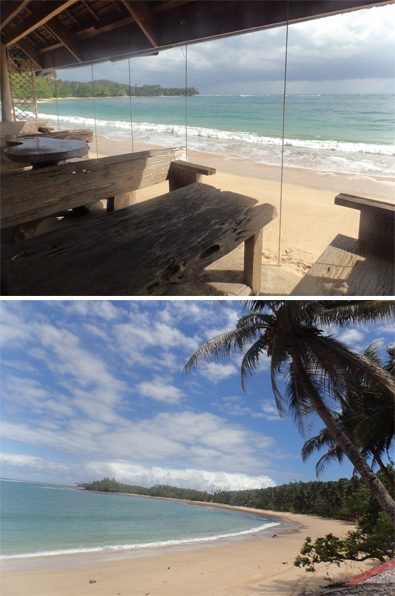
Cagwait White Beach – with its lush backdrop of coconut and vegetation, and its expanse of aquamarine waters – was also referred to as the “Waikiki of the South” by American aviator Charles Augustus Lindbergh after his chance discovery of the area on his visit in Surigao.
When we arrived, my mind automatically expected to feel the powder-like consistency of Boracay’s sands, but I was dismayed. Here, the sand is… coarser. Nevertheless, the view that welcomed us did not disappoint. The white sand shores embraced a portion of the great Pacific Ocean and invited us to its pristine, cool, and clear turquoise waters. My initial dismay was overshadowed by the fact that Cagwait offers what Boracay couldn’t: serene isolation.
I didn’t expect what I discovered next.
We rented non-aircon rooms for 300 pesos a night and the window view was just a spectacular display of the white beach and its gentle blue waves. I just immediately thought of endless days of waking up to the sights and sounds of this view. Spending lazy mornings and afternoons writing and just gazing up to the multitude of stars and seeing their reflections on the bay at night. All the more perfect with my partner.
The whole day was just pure indolence. After feeling hot under the sun with the book I have longed to finish reading, the cool blue waters soothed my sun-kissed skin. The gentle sea breeze was my companion in the long and slow barefoot walks in the stretch of white sand.
I was in a dilemma of writing about this white beach. I was like a little boy unwilling to share my discovered hiding spot. The peace was just too rare to risk for it to be overtly commercialized as what happens to a lot of our island beaches. Yet still for those who truly love beaches, Cagwait offers this true unspoiled experience.


Destinations
Pasalubong shopping in Davao via Aldevinco
#Pasalubong hunting in #Davao? Consider the new, pinasosyal #Aldevinco that may not have the grimy character of the old location but still is worth #LGBT visiting.

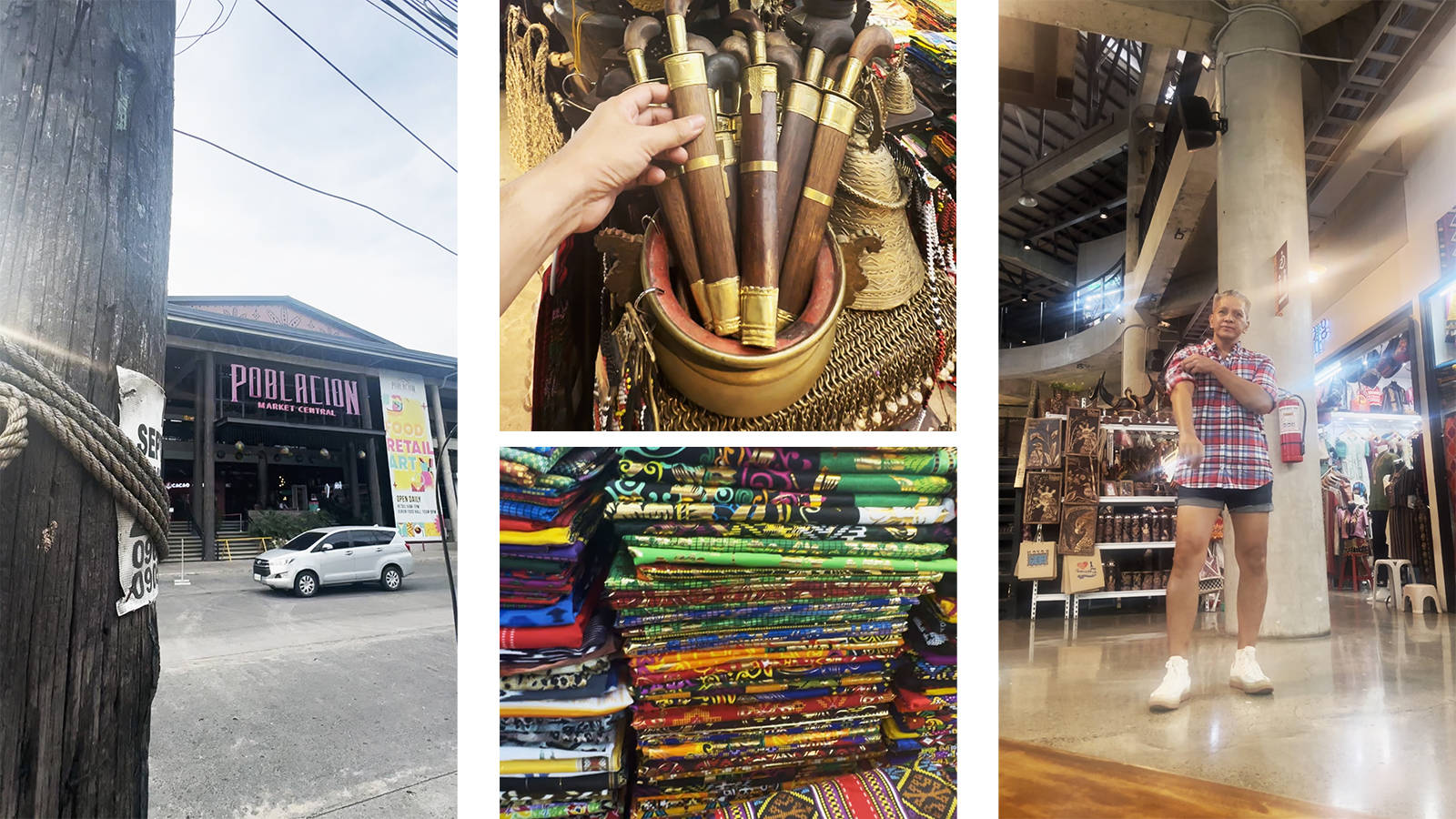
Davao-bound tourists know – or should know – of Aldevinco Shopping Center, the city’s one-stop-hub for everything Mindanao-related. You need malong or patadyong as pasalubong? You need a kulintang not just as a musical instrument, but as décor? You need batik, or T’boli ethnic apparel? You can find them all… and even more, in Aldevinco.
But here’s the thing, particularly for those who do not know yet: the old Aldevinco, which was located along C.M. Recto Street and Roxas Avenue in Davao City, is no more.
Now… enter the new Aldevinco, this time located at Poblacion Market Central on C. Bangoy Street (former Madrazo Fruit Stand)… which isn’t that far from the old place, actually.
We checked, and here are some things worth noting.
@outragemag #Pasalubong hunting in #Davao? Consider the new, pinasosyal #Aldevinco that may not have the grimy character of the old location but still is worth #LGBT ♬ original sound – Outrage Magazine
Una, this place looks and feels new. The old Aldevinco had a palengke feel, but this one has a mall feel. So you have a high-ceilinged venue with better-arranged stores that are air-conditioned, and so on. Pina-sosyal, in a manner of speaking.
Ikalawa, when there, the rules remain the same: haggle. The prices first quoted to you are not the actual prices the goods go for… unless you’re too moneyed and you don’t want to ask for discounts, though in that case, you shouldn’t even be in Aldevinco at all. The more you buy (i.e. bulk buying), the lower the prices, obviously. But always haggle… even if only for the fun of doing it.
Ikatlo, if you have time to spare, don’t auto-buy from the first store you check. Tour the area and compare prices. Often, the goods sold in one store will also be offered in a different store. So move around before making a final decision.
And ika-apat, Aldevinco may be popular as the go-to place for pasalubong, but in truth this isn’t the only one. Halimbawa, right across the old Aldevinco is a series of shops, some of them from the old Aldevinco. Because, at times, Aldevinco can feel like a tourist trap, and understandably, not everyone likes going into one. So consider your other options.
All the same, when in Davao, this is a place worth checking… if not for the shopping, then the food… or at least to check what happened to the tenants of the 60-year-old Aldevinco that was closed in December 2021, and is now being redeveloped into who-knows-what.
All part of rediscovery as we continue the LGBTQIA+ rampa wherever and everywhere…
Open from 9AM to 7PM (with the Kūkūñ Food Hall open from 10AM to 9 PM), Aldevinco Shopping Center is located at Poblacion Market Central, C. Bangoy Street, Davao City.
Destinations
Enjoying the grilling at Mandaue City’s Matias BBQ
#Mandaue City’s #MatiasBBQ is worth checking as your #LGBT alternative to dining in the open in #Cebu.
Seriously considering Larsian to try grilled goods in Cebu City, a friend recommended for us to try, instead, Matias BBQ. “It’s cleaner,” she said, adding: “And yummier, of course.”
So we checked… and how was the visit to Matias BBQ for us?
@outragemag #Mandaue City’s #MatiasBBQ is worth checking as your #LGBT alternative to dining in the open in #Cebu ♬ original sound – Outrage Magazine
Una, the place is NOT in Cebu City. It’s in nearby Mandaue City. We didn’t check where the BBQ place is, exactly; we just took a Grab and pinned the address. We just noted that the travel took a while, and yes, the fare wasn’t cheap (LOL).
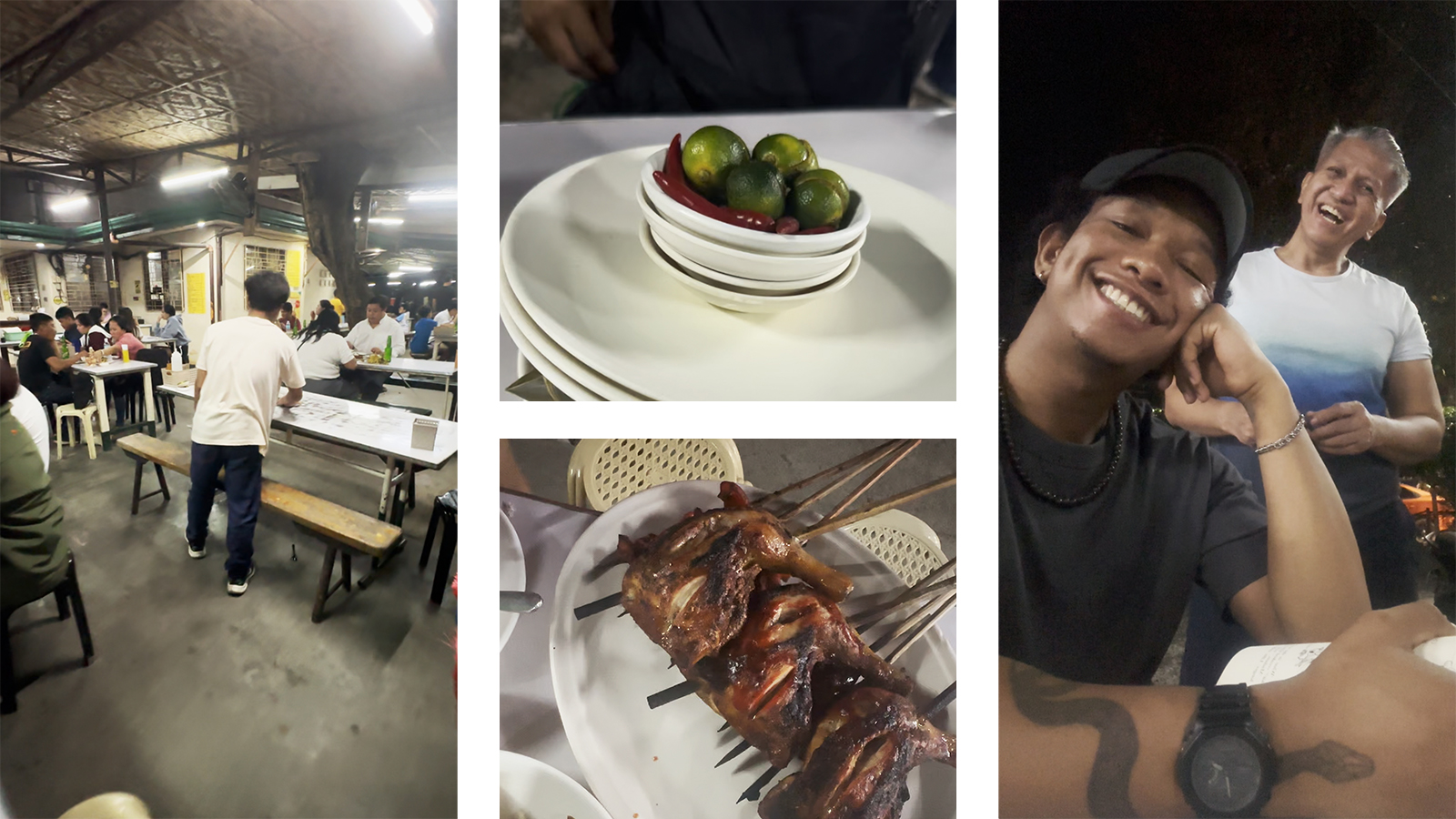
Ikalawa, this is an open-air venue, similar to Larsian, though the difference is, here, there’s just one vendor (Matias BBQ). Maarte people beware: this isn’t for you.
Ikatlo, the servers were friendly… a pleasant surprise considering the number of people they had to serve. They knew what to recommend, and quickly dealt with some concerns (e.g. replace what was deemed stale rice).
Ika-apat, how was the food naman?
- The chicken – including the ₱85 pecho and ₱95 paa – were well-seasoned and well-cooked, remaining moist and not dry. Lasa-wise, they were smoky and sweetish.
- The ₱16 chorizos were actually good, properly cooked so that we were still able to taste the meat and accompanying sahog of garlic and the likes. This made us realize that when deciding to cook longganisa from Cebu, consider grilling instead of frying in oil. It just tastes better that way.
- The ₱165 balbacua (beef rind and oxtail soup) served to us was already cold, so was already greasy. The collagen-rich cuts were soft, and there were okay-tasting veggies, but the broth was already slimy from being oily.
- The ₱12 pusô was inconsistent; some were already stale (perhaps old stocks), and the others fresh. It’s hard to ascertain which is which since you’d be served with a lot. Order freshly-cooked rice if apprehensive… though this takes away from the overall experience of eating in a place like this.
Here’s the thing: our total bill was cheaper than the fare we paid to Grab to go there.
And so, for us, if this is accessible to you, consider this an alternative to, say, the likes of Larsian. That the food is good has to be emphasized, done in an outdoor setting that’d remind you of eating in the probinsiya.
But off we go again, in search of more LGBTQIA+ lagangan venues…
Open from 11.30AM to 8.00PM, Matias BBQ is located along A.S. Fortuna St., Banilad, Mandaue City.
Destinations
Eating out in Cebu in one place via Pusô Village
Checking out #Cebu’s all-in-one dining location, the Pusô Village that may simplify eating out but seems to forget our desire to see diverse #foodie hubs.
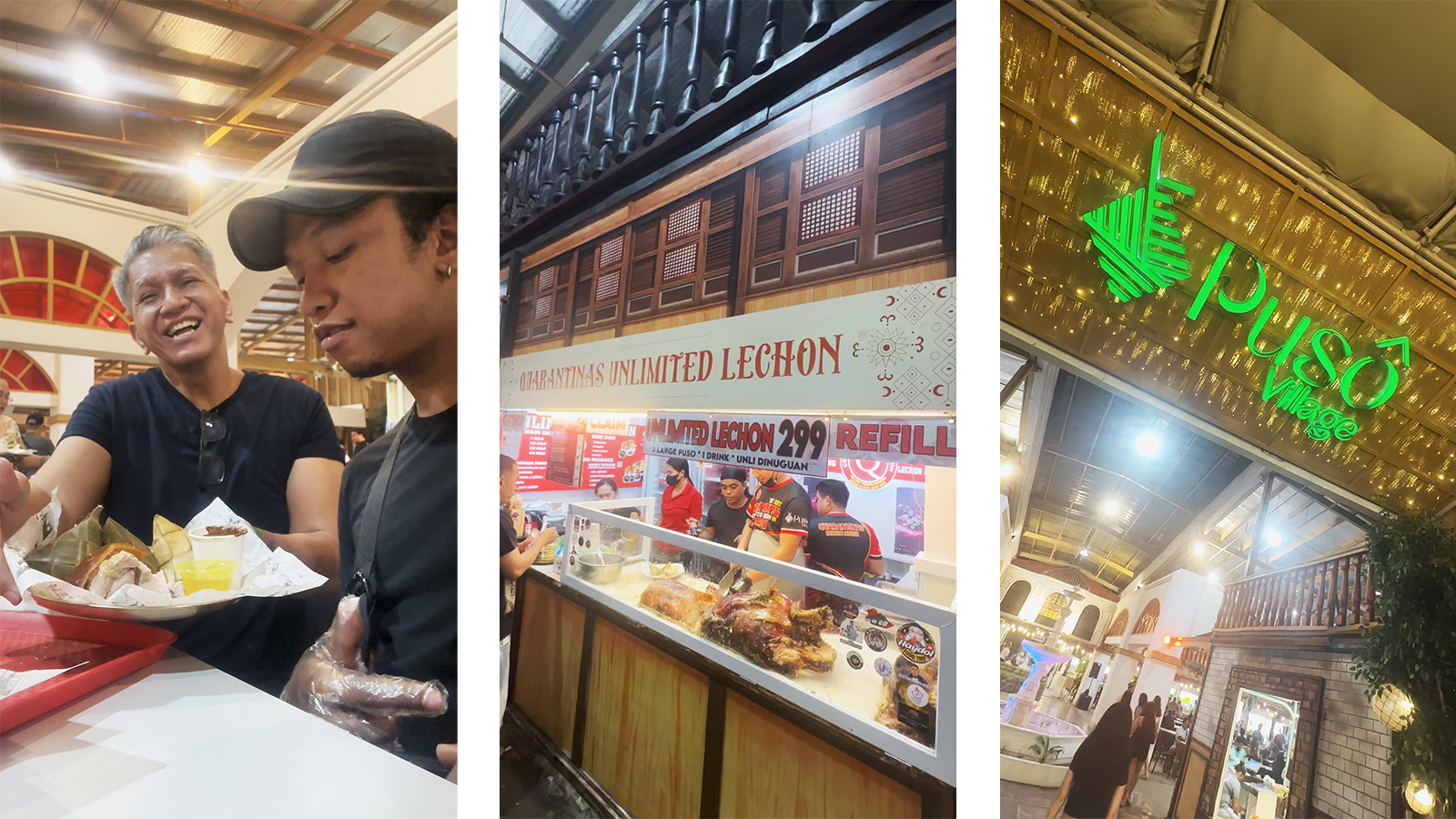
In the past, if you wanted to grab some of the food associated with Cebu, you headed to – among others – Larsian, this place not too far from Fuente Osmeña Circle. It wasn’t necessarily popular with the locals who saw (and still see) it as unhygienic, but it’s this easy-to-access BBQ place that’s open 24/7.
Starting 2025, however, a new place was opened to serve as the one-stop culinary and cultural hub of Cebu City: the Pusô Village.
@outragemag Checking out #Cebu's all-in-one dining location, the Pusô Village (#pusovillage) that may simplify eating out but seems to forget our desire to see diverse #foodie ♬ original sound – Outrage Magazine
Una, developed by Cebu2World/Megawide as part of the Carbon Market modernization, this place’s name drew inspiration from the pusô rice cake that’s served when you have meals in Cebu. There are, therefore, design elements that’d remind you of the pusô – e.g. those octahedral shapes on the entrance. Inside, there are attempts to beautify by borrowing elements from Bahay na bato Philippine architectural style; most are fake, though, such as those painted-on verandahs you’d see when you look up.
Ikalawa, there are over 100 food stalls and retail outlets here… though more of the former than the latter. They’ve been “properly” structured, so that the lechon vendors are on one side, seafood sellers on another side, and so on.
Ikatlo, we tried some of the offerings to ascertain how good they are.
The unlimited lechon is popular, providing an opportunity particularly for non-locals to cheaply enjoy this Cebuano treat. Taste-wise, the lechons vary little, some saltier than the others. The “approach” in serving is similar, though. You get an okay portion when first served, and the portion gets smaller the more you return. Noticeably, by the third refill, the vendors become grumpier when serving you, some even ignoring you, or stuffing fatty parts on your plate. Business greed in action.
Though cooked the same way (i.e. buttered), the seafood platters are inconsistent. You could get some shrimps or crabs now and then, though most times, you’d just get mussels.
Then there’s the tuslob-buwa, pig’s brain cooked under maximum heat to then become dip for pusô. We’d say this is acquired taste… but there’s not much to taste. So this is a costly to-try food.
Only open until 10.00PM, Pusô Village offers those in Cebu a venue to try as many of the local goods as possible. For that, alone, this is a must-check. You are sure to find a few stuffs you’d like.
But the city still has a lot of venues offering local culinary and cultural goods, and they deserve to be also checked. And so off we go for more LGBTQIA+ rampa…
Pusô Village is located at M.L Quezon Blvd., Sto. Nino, Cebu City.

Pasalubong shopping in Davao via Aldevinco

The look and feel of your neighborhood may affect your sleep

Workout or nap? Either can help your sleepless brain, study finds

Study links coffee consumption to metabolic health and sex hormones

Manulife Investments Philippines leads UITF rankings across equity and fixed income funds

Scheduling dental care during prenatal visits boosts oral health care during pregnancy

Enjoying the grilling at Mandaue City’s Matias BBQ

Dogs can distinguish between human fear and sadness

Pet dog microbiota may protect young children from respiratory tract infections and reduce the need for antibiotic courses

Walking and weight training alone are not enough for strong bones – football and handball may be more effective
Scheduling dental care during prenatal visits boosts oral health care during pregnancy
Enjoying the grilling at Mandaue City’s Matias BBQ
Study links coffee consumption to metabolic health and sex hormones
Dogs can distinguish between human fear and sadness
Manulife Investments Philippines leads UITF rankings across equity and fixed income funds
The look and feel of your neighborhood may affect your sleep
Pasalubong shopping in Davao via Aldevinco
Workout or nap? Either can help your sleepless brain, study finds

-
 NewsMakers3 weeks ago
Scheduling dental care during prenatal visits boosts oral health care during pregnancy
-
 Destinations3 weeks ago
Enjoying the grilling at Mandaue City’s Matias BBQ
-
 NewsMakers3 weeks ago
Study links coffee consumption to metabolic health and sex hormones
-
 Pet Care3 weeks ago
Dogs can distinguish between human fear and sadness
-
 Product Showcase3 weeks ago
Manulife Investments Philippines leads UITF rankings across equity and fixed income funds
-
 NewsMakers1 week ago
The look and feel of your neighborhood may affect your sleep
-
 Destinations4 days ago
Pasalubong shopping in Davao via Aldevinco
-
 NewsMakers1 week ago
Workout or nap? Either can help your sleepless brain, study finds