
NewsMakers
Smile Train Phl continues to give forever smiles throughout the pandemic
Aside from cleft surgeries, Smile Train has provided over 3,000 telehealth sessions for speech therapy and nutrition counselling during the pandemic. Smile Train also launched the first-ever Filipino language mobile speech app designed for those born with a cleft to continue learning at home.


Every day around the world, 540 babies are born with a cleft, a serious health condition with potentially life-threatening complications such as difficulty in eating, breathing, hearing, and speaking. Smile Train provides comprehensive cleft care services to individuals born with a cleft and their families. Despite the challenges brought about by the COVID-19 pandemic, Smile Train continued to provide free cleft surgery and care for those in need, including baby Mao.
Novalyn, the mother of baby Mao, had initially lost hope. During his first check-up at another organization, Mao was underweight and could not receive surgery. Shortly after, the pandemic started, causing further delays to receiving treatment. After more than a year, Novalyn was referred to Smile Train by Cristalle Belo, Tim Yap and Javi Martinez. Mao received surgery for his cleft lip last September 2021.
“This life changing procedure of baby Mao is truly such a blessing to their family, and we can’t thank Smile Train enough for making this dream a reality. Can’t wait to see the results after baby Mao has healed,” said Cristalle Belo on her Instagram post.
In 2019, Cristalle Belo met baby Mao during one of her family-owned Belo Medical Group’s outreach activities. Baby Mao was not allowed to receive surgery then as he was not strong enough at the time.
Chef Xavier Btesh, who was there to support the outreach activities, also took an interest in Baby Mao’s case, helping to ensure he goes to his pediatric check-ups and gets his vitamins to be healthy enough for his eventual surgery through Smile Train.
“Para sa mga magulang, huwag pong mawalan ng pag-asa dahil nandyan ang Smile Train laging naka suporta para sa atin at para sa mga anak nating may cleft. Pero hangga’t maari, bilang isang magulang, bilang isang nanay, isa sa mga responsibilidad natin na alagaan ang sarili natin lalo na pag tayo ay mayroong anak na may cleft,” said Mommy Novalyn.
(“For all the parents out there, do not lose hope, Smile Train will always be there to support us and for our children with cleft. However, as much as possible, as a parent, as a mother, one of our responsibilities is to take care of ourselves especially when we have a child with a cleft,” said Mommy Novalyn.)
“Through Smile Train’s sustainable model of partnering with local hospitals and empowering local medical professionals, we are able to provide cleft care throughout the year. This model has allowed us to continue to carefully provide safe, quality and timely surgeries throughout the COVID-19 pandemic,” said Kimmy C. Flaviano, Smile Train Vice President, South East Asia.
Aside from cleft surgeries, Smile Train has provided over 3,000 telehealth sessions for speech therapy and nutrition counselling during the pandemic. Smile Train also launched the first-ever Filipino language mobile speech app designed for those born with a cleft to continue learning at home.
Despite the challenges of the current times, Smile Train remains committed to its vision of a world where everyone has access to safe and comprehensive cleft care and can live a full and healthy life. In just over 20 years, Smile Train has already supported over 65,000 cleft surgeries in the Philippines.
For more information about Smile Train’s global efforts and to donate, please visit smiletrain.org. To learn more about Smile Train’s local programs in the Philippines, please visit smiletrain.ph, follow Smile Train Philippines on Instagram @SmileTrainPh, and like us on Facebook at @SmileTrainPhilippines.





NewsMakers
Why a UTI hurts — and why that might be a good thing
Australian researchers have discovered a previously overlooked group of bladder nerves that help detect urinary tract infections (UTIs) and trigger the body’s response to clear them, providing a potential new target for future bladder pain therapies.
Australian researchers have discovered a previously overlooked group of bladder nerves that help detect urinary tract infections (UTIs) and trigger the body’s response to clear them, providing a potential new target for future bladder pain therapies.
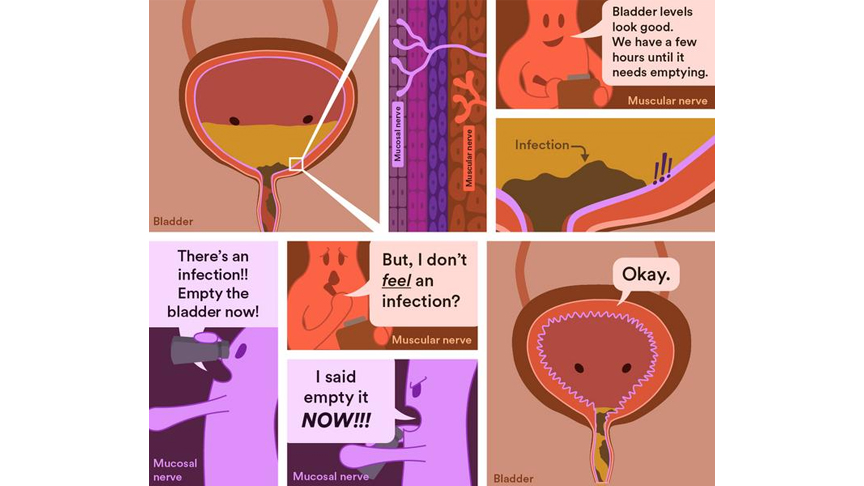
The study shows that bladder nerves located close to the lining of the bladder act as a frontline infection sensor, helping the body recognise UTIs and trigger responses that reduce the severity and spread of infection.
UTIs are among the most common bacterial infections worldwide, with more than 400 million cases reported every year. Nearly one in three women will experience UTIs before the age of 24, and many elderly people and those with bladder issues from spinal cord injuries can experience multiple UTIs in a single year.
Symptoms often include frequent urination, a sudden urge to urinate, pain during urination, and pelvic discomfort can be debilitating for some patients.
Flinders University’s Dr Luke Grundy says that while scientists have long understood how the bladder senses as it fills and triggers urination, the role of a specialised group of bladder nerves near the bladder lining has remained unclear.
“Most bladder nerves act like a fuel gauge, telling the brain when the bladder is filling up and needs emptying,” says Dr Grundy, Head of the NeuroUrology Research Group at Flinders University.
“The nerves we studied in this research are different. They sit close to the bladder lining and appear to act more like an early warning system, detecting infection and inflammation.
“They don’t just sense infection. They help coordinate the body’s response to it by triggering pain and urinary frequency, behaviours that appear to help clear bacteria from the bladder as part of the body’s defence system.”
Lead author and recently graduated PhD student Dr Cindy Tay says the discovery changes how these nerves are understood.
“These mucosal nerves have puzzled scientists for almost two decades because they stay quiet while the bladder fills and empties, which is the main job of the bladder,” says Dr Tay.
“What we’ve found is that they have a hidden job — acting as an early warning system that springs into action the moment infection takes hold.”
The research team developed a novel method to selectively study a specialised group of sensory nerves in the bladder lining of mice, revealing that while these nerves play little role in normal bladder function, they become highly responsive during a UTI and help detect and respond to infection.
“When the bladder is healthy, these nerves are relatively quiet, but during a urinary tract infection they become highly sensitive and respond to the presence of bacteria and inflammation,” says Dr Grundy.
“It may feel unpleasant, but urinating more frequently actually helps clear the infection by flushing out the harmful bacteria.”
The study also helps explain why people with conditions affecting nerve function may be more prone to recurrent or severe UTIs.
“If the nerves that detect infection aren’t working properly, the body may not respond as effectively,” says Dr Grundy.
Building on previous research, the new study reveals a deeper understanding of how UTIs affect bladder function and the nervous system, and could help develop new treatments that target these nerves to relieve UTI-related symptoms.
“Our findings provide new insight into how the bladder detects and responds to infection, helping explain the biological processes that drive the pain, urgency and discomfort commonly experienced during UTIs,” says Dr Grundy
Researchers say the next challenge is to develop therapies that ease the pain and urgency associated with UTIs while preserving the protective role these nerves play in fighting infection.
The paper, ‘Bladder mucosal afferents detect UTI and aid pathogen clearance,’ by Cindy Tay, Harman Sharma, Stewart Ramsay (University of Adelaide), Georgia Bourlotos, Sarah K Manning, Natalie E Stevens, Sophie J Miller, Geraint B Rogers, David J Lynn, Feargal J Ryan, Andrea M Harrington (University of Adelaide), Vladimir Zagorodnyuk, Steven L Taylor and Luke Grundy was published in Proceedings of the National Academy of Sciences (PNAS).
NewsMakers
Pregnancy complications can signal heart disease risk years before traditional screening, study finds
Some women, particularly younger women often considered low risk, may face a higher risk of heart disease earlier than previously recognized.

McGill University researchers have developed a new tool to identify heart disease risk in women earlier in life.
Findings from a study published in JACC: Advances highlight gaps in existing approaches.
“Heart disease is the leading cause of death in women, yet existing risk tools were developed in older populations and ignore factors unique to women,” said senior author Robert Platt, Professor in the Department of Epidemiology, Biostatistics, and Occupational Health and Director of the School of Population and Global Health.
While pregnancy complications are known to be linked to future heart risk, there has been no way to identify which younger women are most at risk, he added.
Detecting risk earlier
Using health data from more than 260,000 women in the UK aged 15 to 45 who had given birth, researchers developed and validated a prediction model to estimate future heart disease risk. Participants were followed for nearly four years after delivery.
The model identified several factors – not included in existing tools – that can help predict risk, including hypertensive disorders of pregnancy, gestational diabetes, preterm birth, PCOS, depression, thyroid disorders, oral contraceptive use and social deprivation.
The findings suggest some women, particularly younger women often considered low risk, may face a higher risk of heart disease earlier than previously recognized.
“Millions of women who give birth each year are never considered candidates for cardiovascular risk assessment simply because of their age,” said co-author Kristian Filion, Professor in the Departments of Medicine and of Epidemiology, Biostatistics, and Occupational Health.
If integrated into routine postpartum care, this tool could enable earlier monitoring, lifestyle counselling or referral to a specialist, potentially helping prevent a heart attack or stroke later in life, he added.
The next step is to validate the model in Canada and the United States. In the longer term, the goal is to integrate a practical calculator into electronic health records so higher-risk patients can be identified earlier.
About the study
“Development and Validation of a Prediction Model for Cardiovascular Risk in Reproductive-Aged Women” by Sonia Grandi, Kristian Filion, Jennifer Hutcheon, Graeme Smith, and Robert Platt was published in JACC: Advances. The study was supported by the Canadian Institutes of Health Research.
NewsMakers
Posture can influence your mood and behavior, study suggests
The findings do not mean that changing posture can dramatically transform a person’s life, but it does raise interesting questions about whether everyday features of our environment – such as workplace ergonomics – can subtly influence mood and behavior.

A person’s posture appears to affect their emotions and decision-making ability more than they realize, according to new research from McGill University. In a recent study, participants sitting upright performed better at a risk-taking task and reported more positive feelings than did their peers in the slouching or control groups.
Though the effects were modest and observed in a laboratory setting, the results highlight the body’s influence on our mood and behavior, said Jorge Armony, professor in the Departments of Psychiatry and Psychology at McGill and senior author of the study.
A cover story to influence body position
Armony and graduate student Soren Wainio-Theberge, who originated the idea for the research and is a co-author of the paper, recruited nearly 200 participants from the McGill community.
After some initial testing on a computer monitor, they asked them to complete a new task on a tablet, under the guise of testing a mobile application. For some, the tablet was positioned on a stand on an adjustable table, to encourage an upright posture while sitting. For others, it was placed flat on the desk, which was also positioned at a lower setting, prompting participants to hunch over.
Participants then completed a risk-taking test, in which players can earn rewards by inflating a virtual balloon, but risk losing everything if it bursts. Over the course of the task, participants in the upright posture took greater risks and tended to earn greater rewards.
“This suggests they were not acting more impulsively but rather were engaging in more effective risk-taking,” explained Armony.
In the accompanying questionnaire, participants in the upright group also reported significantly higher feelings of pride, which is associated with a positive mood.
Bringing new insight to posture research
The findings shed light on the long-debated notion that the body’s posture can influence the mind.
The McGill team tested this relationship while avoiding concerns associated with previous studies.
The researchers avoided telling subjects which posture to adopt, but, rather, influenced their choice without their knowledge. This helped address a common criticism of earlier “power pose” research: that results may simply reflect that participants responded to researchers’ expectations. In post-experiment interviews, most participants indicated that they were unaware their posture had been manipulated.
The researchers also used video software to measure neck angle as a benchmark for posture conformity. In previous studies, this had not often been measured.
The findings do not mean that changing posture can dramatically transform a person’s life, Armony cautioned, but it does raise interesting questions about whether everyday features of our environment – such as workplace ergonomics – can subtly influence mood and behavior.
About the study
“Manipulating posture implicitly through environmental constraints influences mood and
risk-taking behaviour”, by Soren Wainio-Theberge and Jorge Armony, was published in the British Journal of Psychology.

Pet dog microbiota may protect young children from respiratory tract infections and reduce the need for antibiotic courses

Walking and weight training alone are not enough for strong bones – football and handball may be more effective

Keeping kitty indoors is not the cat-astrophe that owners fear

Why a UTI hurts — and why that might be a good thing

Pregnancy complications can signal heart disease risk years before traditional screening, study finds

Posture can influence your mood and behavior, study suggests

Eating out in Cebu in one place via Pusô Village

Filipinos prioritize independence as legacy for longer lives

Going Chinese in Pulilan, Bulacan

Coffee and heart health: How many cups of caffeinated coffee are safe to drink each day?

Superbod Movement goes beyond the stage
Filipinos prioritize independence as legacy for longer lives

Poor-quality sleep involves different parts of the brain, depending on age

Weight loss drugs could help with binge eating disorder

Loneliness strongly linked to poorer mental health and wellbeing, study finds

New IKEA PS Collection brings playful functionality into your home

Fullerton Health celebrates two years of advancing preventive healthcare in PH

Century Tuna Superbods 2026 announces ‘Superbod Era’ finalists
Coffee and heart health: How many cups of caffeinated coffee are safe to drink each day?

Manulife China Bank Life expands access to cancer care solutions

-
 Product Showcase4 weeks ago
Superbod Movement goes beyond the stage
-
 NewsMakers1 week ago
Filipinos prioritize independence as legacy for longer lives
-
 NewsMakers3 weeks ago
Poor-quality sleep involves different parts of the brain, depending on age
-
 NewsMakers3 weeks ago
Weight loss drugs could help with binge eating disorder
-
 NewsMakers3 weeks ago
Loneliness strongly linked to poorer mental health and wellbeing, study finds
-
 Product Showcase3 weeks ago
New IKEA PS Collection brings playful functionality into your home
-
 Product Showcase3 weeks ago
Fullerton Health celebrates two years of advancing preventive healthcare in PH
-
 Product Showcase4 weeks ago
Century Tuna Superbods 2026 announces ‘Superbod Era’ finalists