
Travel
Philippines as the country with the world’s largest bats
“The Philippines has 79 recorded bat species, half of them endemic,” explains Dr. Mariano Roy Duya of the University of the Philippines Institute of Biology (UPIB). North America, with a land area that is 66 times larger – has but 45. We have an incredible diversity of bats since each of our 7100 islands is geographically unique. And of course, we have the largest bat of all.”


By Gregg Yan
Did you know that the largest bat of all is found only in the Philippines? Planet Earth has 1400 known bat species and the Golden-crowned Flying Fox (Acerodon jubatus) earns the top spot for size and weight. Known locally as kabog, it is endemic or found nowhere else but in the Philippines.
Strikingly patterned with a golden cap, reddish fur and chocolate-brown wings, adults weigh over a kilogram and can boast of a wingspan nearly two meters across – longer than most people are tall.
“The Philippines has 79 recorded bat species, half of them endemic,” explains Dr. Mariano Roy Duya of the University of the Philippines Institute of Biology (UPIB). North America, with a land area that is 66 times larger – has but 45. We have an incredible diversity of bats since each of our 7100 islands is geographically unique. And of course, we have the largest bat of all.”
Once widespread throughout undisturbed lowland forests across the country, hunting and deforestation – particularly from slash-and-burn upland farming or kaingin – have whittled down bat populations.
Dumaguete-based filmmaker Rhiyad Maturan and I were recently invited by the Energy Development Corporation (EDC) to film a thriving kabog colony inside the Bacon-Manito Geothermal Project, a heavily forested geothermal reservation nestled between the provinces of Albay and Sorsogon on the island of Luzon. Though the area is now verdant and alive, it wasn’t always so.

“Believe it or not, that entire mountain range was once logged-over,” says Ed Jimenez, corporate relations head for EDC’s Bacon-Manito Geothermal Project, pointing at well-forested hills nearby. “The only trees left were the ones loggers ignored. To bring the mountains back to life, we worked with the local communities to help reforest this area while providing them with an alternative source of income. Decades later, the organizations we helped form, like the Alliance of Bacman Farmer’s Association Inc. Agriculture Cooperative (formerly ALBAFAI) and the Bacman Host Community Multi-purpose Cooperative (BMPC), have become some of our most passionate champions. Even the grandchildren of the original members are helping us plant trees, promote community-based conservation and protect these forests.”
Aside from bats, Bicol’s forests also shelter wild deer, pigs, monkeys and birds – most of which were driven to remote areas by decades of hunting and forest loss.
“I learned to shoot kabog with an airgun when I was still a kid,” recalls Joseph ‘Doy’ Gabion, a former bat hunter. “Bats are easy to hunt by day because they hang upside down from their roosts. When the roosts were eventually protected by EDC and its conservation partners, we hunters had to wait until the bats flew out to their feeding grounds. Back in the 1990s, my uncle and I would wait for them to pass to be able to catch two or three bats a night. Kabog meat has a slightly woody taste.” Doy has since stopped hunting and now volunteers with the Armed Forces of the Philippines’ CAFGU Active Auxiliary Unit II to help protect the very animals he once hunted.
The kabog colony moves from one area to another within the Bacman reservation and we chanced upon them roosting on a grove of pine-like Agoho (Casuarina spp.) trees. “We have about 700 kabog individuals here now, our flagship fauna species for this site,” explains Forester Neil Miras, EDC Bacman’s watershed management officer.
Representing iconic wildlife found in its geothermal, solar and wind sites, EDC’s Flagship Species Initiative (FSI) aims to popularize some of the nation’s lesser-known forest denizens. The eight other flagship species include the Philippine Warty Pig (Sus philippensis), Visayan Hornbill (Penelopides panini), Apo Myna (Goodfellowia miranda), plus native trees like Mapilig (Xanthostemon bracteatus), Katmon Bayani (Dillenia megalantha), Red Lauan (Shorea negrosensis),Almaciga (Agathis philippinensis)andIgem-dagat (Podocarpus costalis). EDC has been planting native trees across the country since the 1980s.
“Though millions of trees have been planted under the BINHI Program, we should still recognize the importance and effectiveness of natural seed dispersion – either by the wind, water or by local wildlife,” explainsForester Abegail Gatdula, EDC-FSI project manager. “Flying animals like birds and bats eat the fruits of various forest trees and disperse them far and wide within life-giving guano bombs, giving the seeds a vital headstart.”
Though not as popular as the Tamaraw or Philippine Eagle, the kabog has been quietly doing its part to make the Philippines greener. “Think of them as the ‘silent seed planters’ of nature. We never pay them but they keep working for our world,” concludes Jean Dayap, Municipal Environment and Natural Resources Officer (MENRO) of Manito in Albay.

So tonight, please look up at the night sky to thank our uncelebrated wildlife heroes, quietly working the night shift to make the Philippines a little greener – one guano bomb at a time.
Watch our Golden-crowned Flying Fox documentary HERE.


Destinations
Eating out in Cebu in one place via Pusô Village
Checking out #Cebu’s all-in-one dining location, the Pusô Village that may simplify eating out but seems to forget our desire to see diverse #foodie hubs.

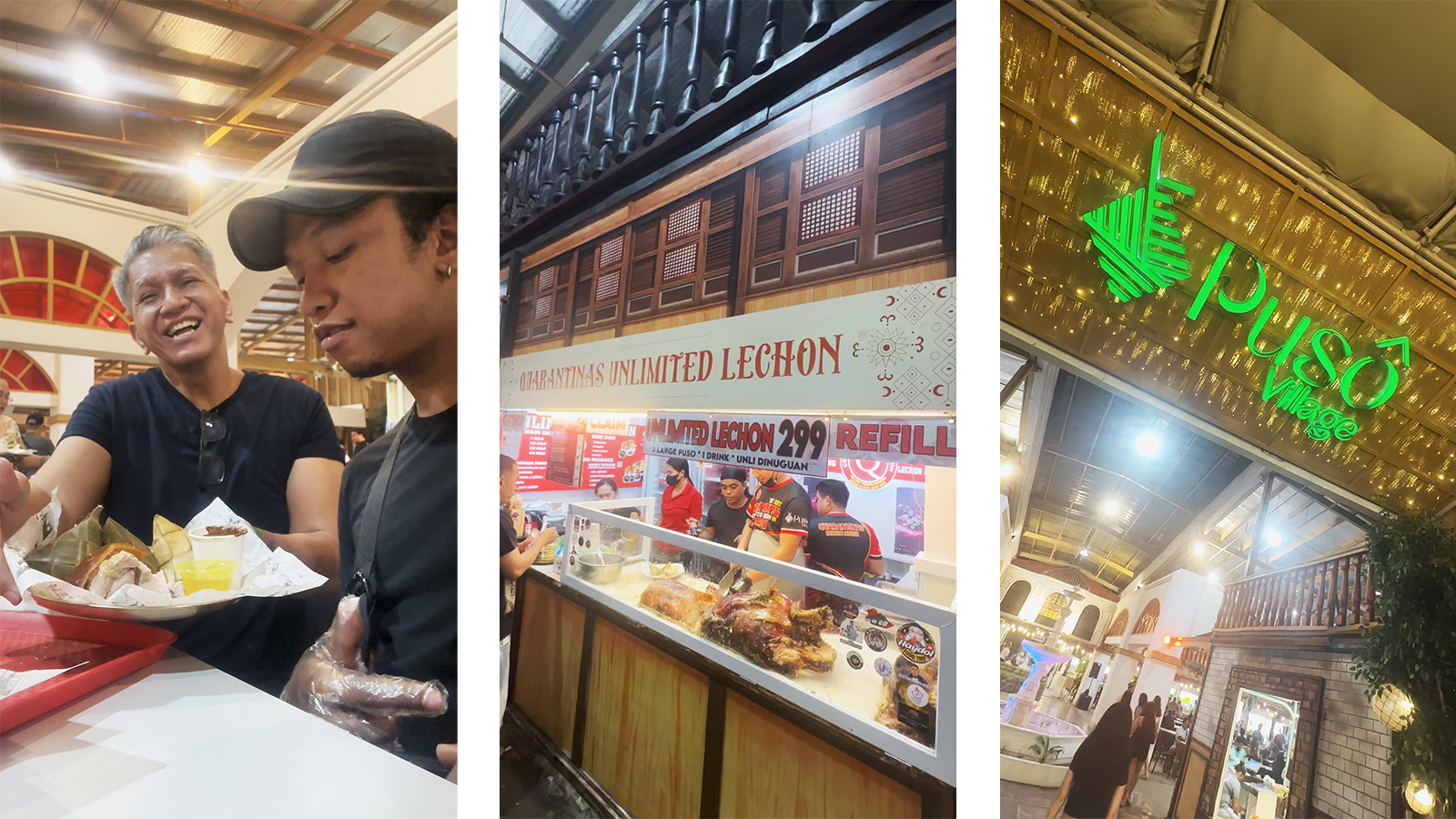
In the past, if you wanted to grab some of the food associated with Cebu, you headed to – among others – Larsian, this place not too far from Fuente Osmeña Circle. It wasn’t necessarily popular with the locals who saw (and still see) it as unhygienic, but it’s this easy-to-access BBQ place that’s open 24/7.
Starting 2025, however, a new place was opened to serve as the one-stop culinary and cultural hub of Cebu City: the Pusô Village.
@outragemag Checking out #Cebu's all-in-one dining location, the Pusô Village (#pusovillage) that may simplify eating out but seems to forget our desire to see diverse #foodie ♬ original sound – Outrage Magazine
Una, developed by Cebu2World/Megawide as part of the Carbon Market modernization, this place’s name drew inspiration from the pusô rice cake that’s served when you have meals in Cebu. There are, therefore, design elements that’d remind you of the pusô – e.g. those octahedral shapes on the entrance. Inside, there are attempts to beautify by borrowing elements from Bahay na bato Philippine architectural style; most are fake, though, such as those painted-on verandahs you’d see when you look up.
Ikalawa, there are over 100 food stalls and retail outlets here… though more of the former than the latter. They’ve been “properly” structured, so that the lechon vendors are on one side, seafood sellers on another side, and so on.
Ikatlo, we tried some of the offerings to ascertain how good they are.
The unlimited lechon is popular, providing an opportunity particularly for non-locals to cheaply enjoy this Cebuano treat. Taste-wise, the lechons vary little, some saltier than the others. The “approach” in serving is similar, though. You get an okay portion when first served, and the portion gets smaller the more you return. Noticeably, by the third refill, the vendors become grumpier when serving you, some even ignoring you, or stuffing fatty parts on your plate. Business greed in action.
Though cooked the same way (i.e. buttered), the seafood platters are inconsistent. You could get some shrimps or crabs now and then, though most times, you’d just get mussels.
Then there’s the tuslob-buwa, pig’s brain cooked under maximum heat to then become dip for pusô. We’d say this is acquired taste… but there’s not much to taste. So this is a costly to-try food.
Only open until 10.00PM, Pusô Village offers those in Cebu a venue to try as many of the local goods as possible. For that, alone, this is a must-check. You are sure to find a few stuffs you’d like.
But the city still has a lot of venues offering local culinary and cultural goods, and they deserve to be also checked. And so off we go for more LGBTQIA+ rampa…
Pusô Village is located at M.L Quezon Blvd., Sto. Nino, Cebu City.
Destinations
Going Chinese in Pulilan, Bulacan
Craving for #chinesefood in #Bulacan? We tried the offerings of Lee Foo Panciteria #Pulilan, and we’re on the fence here (yes if no choice, no if you can go elsewhere).
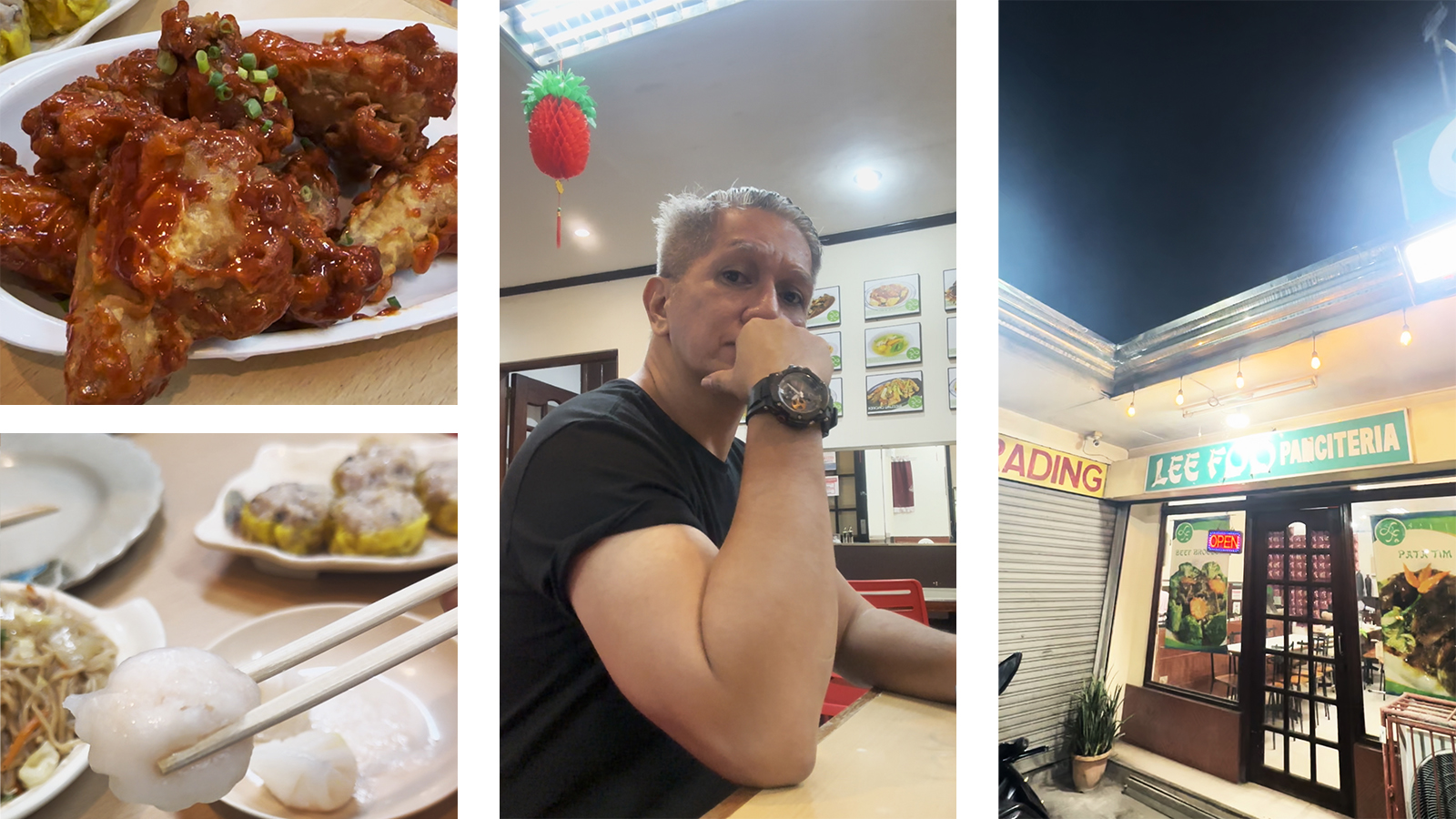
We happened to be in Pulilan in Bulacan, and I had pancit craving. As if on cue, we passed by Lee Foo Panciteria Pulilan, which – after we Google-checked – is supposedly one of the more frequently-visited Chinese restos in these parts of the province, so… of course we checked.
@outragemag Craving for #chinesefood in #Bulacan? We tried the offerings of Lee Foo Panciteria #Pulilan ♬ original sound – Outrage Magazine
Una, this place is really, REALLY easy to find. Located along the Pulilan Regional Road in Barangay Cut-cot in Pulilan, this is right in the middle of the municipality.
Ikalawa, the resto is actually divided into three parts: one side is for those with reservations, another part is for walk-in diners, and another part is for events. If/when the resto isn’t full, only the main part (middle one) is kept open.
No, this isn’t some fancy resto. More like an airconditioned karinderya, complete with wooden tables and plastic chairs. Look-wise, it wasn’t dirty naman when we were there, so that’s a plus.
Ikatlo, the workers were friendly naman… and they moved fast – e.g. while waiting for our orders, we were given must-check peanuts, and since we finished what we got fast, our waitress was more than happy to accommodate us.
Ika-apat, now… how was the food?
The house specialty, the Lee Foo Chicken (₱265 for half, ₱495 for whole), looked like fried chicken with ketchup. Okay… the breading was okay since it didn’t overpower the meat. The chicken, too, was properly cooked, and it wasn’t dry. But it was tasteless overall; so the ketchup taste is what stays with you.
The Pancit Canton Bihon (₱255) had thin pancit noodles, almost as thin as the bihon. It didn’t have lots of sahog; instead, you’d notice the extenders (like kikiam, and so on). I like good pancit, I swear… but this isn’t one of them, sorry.
The weirdly-wrapped Hakaw (₱155) was small, so it was bitin.
And then there’s the Siomai Steam (₱155), which was, in a word, weird. The size was good, similar to those ₱10 siomais. But the way this was prepared was weird for us – e.g. like the meat was overwatered, and having a hard time staying solid, so that it was smudgy, and disintegrated in the mouth even without chewing. I suppose that, at least, it wasn’t disgusting taste-wise.
Lee Foo Panciteria Pulilan is, we believe, popular. Like President in Chinatown, or a branch of David’s in some mall. To each his or her own nga naman. But for us, we’re off to look for other Chinese restos na muna as we head out in search of more lafangan venues.
Lee Foo Panciteria Pulilan is located at 159 Barangay Cut-cot, Pulilan, 3005 Bulacan Province. For more information, contact 0925 800 0168, or email leefoopanciteria@yahoo.com.
Travel
Treacherous beauty: Hiking at South Stack Lighthouse in Wales
#Lighthouse fever in #Holyhead, #anglesey via the #SouthStackLighthouse, as checked during this #LGBT trip to #Wales.

Yes, tech has made many lighthouses redundant. Not that they’re no longer relevant. But navigation-wise, we know we have more advanced solutions. Which, perhaps not surprisingly, led to the reconfiguration of many of them.
In Holyhead, Anglesey in Wales, introducing the South Stack Lighthouse.
@outragemag #Lighthouse fever in #Holyhead, #anglesey via the #SouthStackLighthouse, as checked during this #LGBT trip to #Wales ♬ original sound – Outrage Magazine
Una, you’d need a ride to be there. Some use private cars, as we did; others join tours; and others cycle to the place.
Ikalawa, what’s there?
The lighthouse itself is located on a small, rocky island off Holyhead. From afar, it looks like someone’s grand home; mansion-like. Accessible siya after you descend down 400 steep steps.
What will you see while there?
- the former lighthouse engine room
- the top of the lighthouse
- South Stack is also home to breeding seabirds including guillemots, razorbills and puffins
Here’s an FYI: seasonal lang siya bukas.
This is a must-check for lighthouse lovers, of course. Historic, it was built in 1809 by Trinity House from the design of Daniel Alexander. 91-foot tall, it used to allow safe passage for ships on the Dublin–Holyhead–Liverpool sea route.
Another FYI: It is allegedly haunted, and has been visited by a team from “Most Haunted”.
The area housing the lighthouse is, itself, worth checking. There are trails for hikers or joggers or cyclists; though the same could be enjoyed by those who are there only to look for good shots.
Check when you’re in the area… even if you just pass by. Nice siya, promise.
But off we go for more LGBTQIA+ rampa…

Pet dog microbiota may protect young children from respiratory tract infections and reduce the need for antibiotic courses

Walking and weight training alone are not enough for strong bones – football and handball may be more effective

Keeping kitty indoors is not the cat-astrophe that owners fear

Why a UTI hurts — and why that might be a good thing

Pregnancy complications can signal heart disease risk years before traditional screening, study finds

Posture can influence your mood and behavior, study suggests

Eating out in Cebu in one place via Pusô Village

Filipinos prioritize independence as legacy for longer lives

Going Chinese in Pulilan, Bulacan

Coffee and heart health: How many cups of caffeinated coffee are safe to drink each day?

Superbod Movement goes beyond the stage
Filipinos prioritize independence as legacy for longer lives

Poor-quality sleep involves different parts of the brain, depending on age

Loneliness strongly linked to poorer mental health and wellbeing, study finds

Weight loss drugs could help with binge eating disorder

New IKEA PS Collection brings playful functionality into your home

Fullerton Health celebrates two years of advancing preventive healthcare in PH

Century Tuna Superbods 2026 announces ‘Superbod Era’ finalists

Manulife China Bank Life expands access to cancer care solutions
Coffee and heart health: How many cups of caffeinated coffee are safe to drink each day?

-
 Product Showcase4 weeks ago
Superbod Movement goes beyond the stage
-
 NewsMakers1 week ago
Filipinos prioritize independence as legacy for longer lives
-
 NewsMakers3 weeks ago
Poor-quality sleep involves different parts of the brain, depending on age
-
 NewsMakers3 weeks ago
Loneliness strongly linked to poorer mental health and wellbeing, study finds
-
 NewsMakers3 weeks ago
Weight loss drugs could help with binge eating disorder
-
 Product Showcase3 weeks ago
New IKEA PS Collection brings playful functionality into your home
-
 Product Showcase3 weeks ago
Fullerton Health celebrates two years of advancing preventive healthcare in PH
-
 Product Showcase3 weeks ago
Century Tuna Superbods 2026 announces ‘Superbod Era’ finalists