
Destinations
Freshwater appreciation via Lake Pandin
Zest Magazine heads to Lake Pandin in San Pablo, Laguna.


Yeah, whenever we think of going swimming, we almost always think of going to the beach. In the Philippines, this is not at all surprising, considering that we have – as Charlene Gonzales once (in)famously stated – 7,108 islands (during low tide), less one if it’s high tide. But not as emphasized (though definitely high time that we should) is the abundance of other bodies of water in the Philippines, aside from saltwater. I’d say that for every El Nido (in Palawan) is a Lake Agco (at the foot of Mt. Apo, the country’s highest peak)…
At least this was the very thought running through our heads when we raced to Lake Pandin, a body of water somewhat trapped somewhere in San Pablo in Laguna. Rustic comes to mind when here, with everything seemingly slowing down, as people (okay, tourists!) are paddled into the midst of the lake. And while there, everything becomes… poetic, particularly when the sun hits the waters, when just about everything turns green – mossy sans the reflection (as if something is lurking underneath) and then somewhat neon-ish when reflecting the sun’s rays (reminiscent of… Flubber, or merpeople, or the radioactive goo that turns mortal beings into superheroes/villains).
And with Lake Pandin, yes, there are (other, non-saltwater) bodies of water, indeed, that deserve to be discovered…






Lake Pandin is a somewhat “new” tourist destination that (get this) an all-woman organization started to tap after they realized it can help them make a living to help with the expenses in financing their families. In 2005, a total of 18 local women formed the Samahan ng mga Kababaihang Mangingisda at Bangkera sa Lawa ng Pandin because – as their prexy Cristina Abgrego said – “naisip naming maghanap ng kabuhayan para tulungan ang mga naghahanapbuhay sa mga bahay namin (we thought of finding a way to earn to help those who make a living for our homes).”
These women were, incidentally, already making some form of living catching fish from Lake Pandin, since most of them live in the area anyway. The formation of the association was, instead, a “leveling up” of that “making a living”, Abgrego said.
And so using the balsa (bamboo rafts) that they had, they started “touring” people into Lake Pandin.
The “tour” is simple:
- When you reach the bank of Lake Pandin, there’s a waiting area where you do the transacting for the tour (e.g. pay the fees, choose the type of tour).
- The bamboo rafts have bangkero/bangkera (man/woman who does the paddling) assigned to them.
- After agreeing on the payment/actual payment of fees, you are then queued. It’s a “first come, first served” arrangement, so tourists who arrived early will board a balsa You don’t get to choose the bangkero/bangkera (normally); instead, you’d board the available balsa that’s there (and have its accompanying guide/s) when it’s your turn.
- A “waiting period” happens when stuff need to be put onboard – e.g. food that you paid for.
- The guides do not paddle; instead, they just pull a rope (tied from one end of the lake to the other), which then brings the bamboo raft into the lake. There are “stops” – e.g. where the swing is (at the opposite end of the lake, coming from the take-off point), in the middle of the lake (where you can do some swimming), and so on.
- No swimming is allowed without a life vest. As per Abgrego, at least two tourists drowned in a different lake near Lake Pandin, so the local government told them (sounded to me like “threatened”) that their local effort will be forcibly closed if something like that happened there. There is, however, this awareness that it somehow seemed like a veiled threat that their effort to be sustainable – because it proved successful – will be taken from them so that the earnings will then go directly to the local government…
- While in the lake, you can eat the stuff you paid for (part of the package); go swimming; sunbathe; fish; or… do nothing.
- After two hours, the “tour” ends. You’d be taken back to the bank where it all started, and… so long/until next time.
The association now has 12 bamboo rafts – more than enough to tour the tourists who flock to the place particularly during summer; and more than enough to help support the now 22 members of the association.
And – by the way – they don’t just have all women members now; there is also a transman (there used to be two, but the other one moved overseas already), as well as four men (since they still consider the transman as “one of the girls”) who “do things women won’t do,” Abgrego said, “like replace the bamboos in the rafts.”
Truth be told, there’s not much in Lake Pandin (and so not much to do there).
That is, you don’t come here to – say – go swimming the entire day, picnic with the entire family (again for the entire day), or have water activities (e.g. wakeboarding or kiteboarding or whatever). The trip there will be very specific – i.e. go out in the water to swim for a few hours, grab some chow, then head back home. Now, if this isn’t your idea of “fun”, then Lake Pandin is obviously not for you.
But if the intention is to experience something largely undeveloped; to be in a still-rustic place; to be able to help (empower) a group of women who prove that adage that “if you teach a woman to fend for herself, she’d fend for her entire family”; to mingle with #KaraniwangTAO (and they even have a #KaraniwangLGBT, well-respected, as per the women we spoke with); or to be in a body of water that CAN charm, give Lake Pandin a chance to be experienced.
p.s.
We “lost” a rainbow flag in (the waters of) Lake Pandin. The wind blew so hard, one of Outrage Magazine’s rainbow flags fell in the water. No chance to retrieve it, so it’s there somewhere…
If you happen to find it, you may want to hand it over to the LGBT member of the association overseeing the tour (as Abgrego said: “We’re happy we have them here”). Else, give us a call/yell. Or… just enjoy how a rainbow is not part of the green waters of Lake Pandin…






Lake Pandin is located in San Pablo, Laguna. As soon as you reach San Pablo, there are tourist guides who will offer (for a minimal fee, of course) to bring you to the take-off area of Lake Pandin. At that take-off area is where the paying of the actual fees happen – usually from P350 per person per trip, or (if there aren’t many people) from P400 per person per trip. The payment often includes a meal (usually rice plus three kinds of viands, bananas, and bottled water).


Destinations
Enjoying the grilling at Mandaue City’s Matias BBQ
#Mandaue City’s #MatiasBBQ is worth checking as your #LGBT alternative to dining in the open in #Cebu.
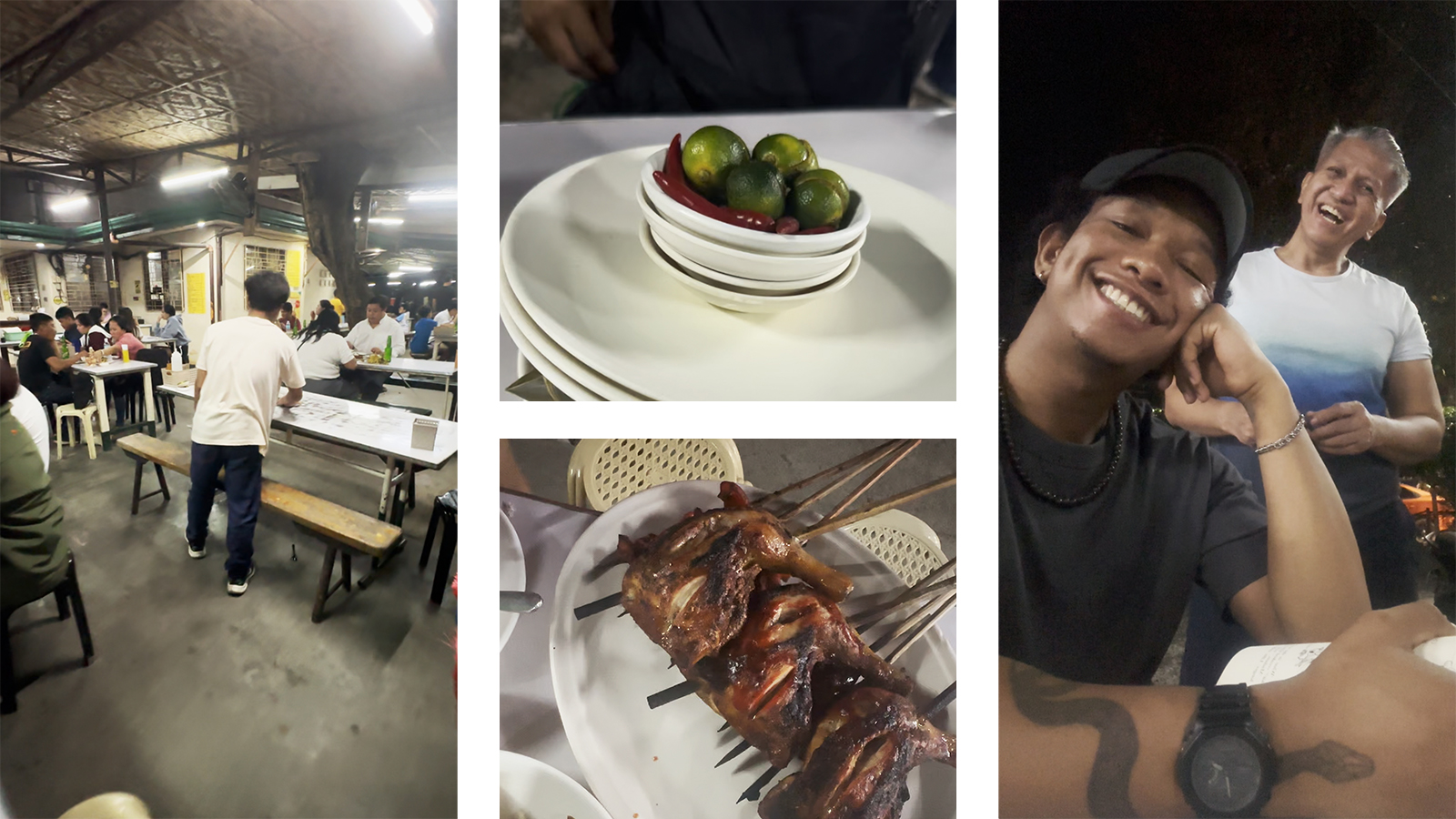
Seriously considering Larsian to try grilled goods in Cebu City, a friend recommended for us to try, instead, Matias BBQ. “It’s cleaner,” she said, adding: “And yummier, of course.”
So we checked… and how was the visit to Matias BBQ for us?
@outragemag #Mandaue City’s #MatiasBBQ is worth checking as your #LGBT alternative to dining in the open in #Cebu ♬ original sound – Outrage Magazine
Una, the place is NOT in Cebu City. It’s in nearby Mandaue City. We didn’t check where the BBQ place is, exactly; we just took a Grab and pinned the address. We just noted that the travel took a while, and yes, the fare wasn’t cheap (LOL).
Ikalawa, this is an open-air venue, similar to Larsian, though the difference is, here, there’s just one vendor (Matias BBQ). Maarte people beware: this isn’t for you.
Ikatlo, the servers were friendly… a pleasant surprise considering the number of people they had to serve. They knew what to recommend, and quickly dealt with some concerns (e.g. replace what was deemed stale rice).
Ika-apat, how was the food naman?
- The chicken – including the ₱85 pecho and ₱95 paa – were well-seasoned and well-cooked, remaining moist and not dry. Lasa-wise, they were smoky and sweetish.
- The ₱16 chorizos were actually good, properly cooked so that we were still able to taste the meat and accompanying sahog of garlic and the likes. This made us realize that when deciding to cook longganisa from Cebu, consider grilling instead of frying in oil. It just tastes better that way.
- The ₱165 balbacua (beef rind and oxtail soup) served to us was already cold, so was already greasy. The collagen-rich cuts were soft, and there were okay-tasting veggies, but the broth was already slimy from being oily.
- The ₱12 pusô was inconsistent; some were already stale (perhaps old stocks), and the others fresh. It’s hard to ascertain which is which since you’d be served with a lot. Order freshly-cooked rice if apprehensive… though this takes away from the overall experience of eating in a place like this.
Here’s the thing: our total bill was cheaper than the fare we paid to Grab to go there.
And so, for us, if this is accessible to you, consider this an alternative to, say, the likes of Larsian. That the food is good has to be emphasized, done in an outdoor setting that’d remind you of eating in the probinsiya.
But off we go again, in search of more LGBTQIA+ lagangan venues…
Open from 11.30AM to 8.00PM, Matias BBQ is located along A.S. Fortuna St., Banilad, Mandaue City.
Destinations
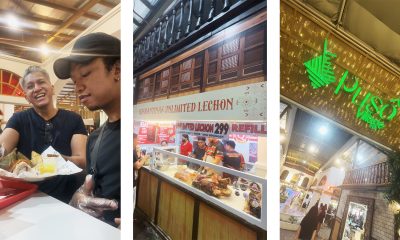
Eating out in Cebu in one place via Pusô Village
Checking out #Cebu’s all-in-one dining location, the Pusô Village that may simplify eating out but seems to forget our desire to see diverse #foodie hubs.
In the past, if you wanted to grab some of the food associated with Cebu, you headed to – among others – Larsian, this place not too far from Fuente Osmeña Circle. It wasn’t necessarily popular with the locals who saw (and still see) it as unhygienic, but it’s this easy-to-access BBQ place that’s open 24/7.
Starting 2025, however, a new place was opened to serve as the one-stop culinary and cultural hub of Cebu City: the Pusô Village.
@outragemag Checking out #Cebu's all-in-one dining location, the Pusô Village (#pusovillage) that may simplify eating out but seems to forget our desire to see diverse #foodie ♬ original sound – Outrage Magazine
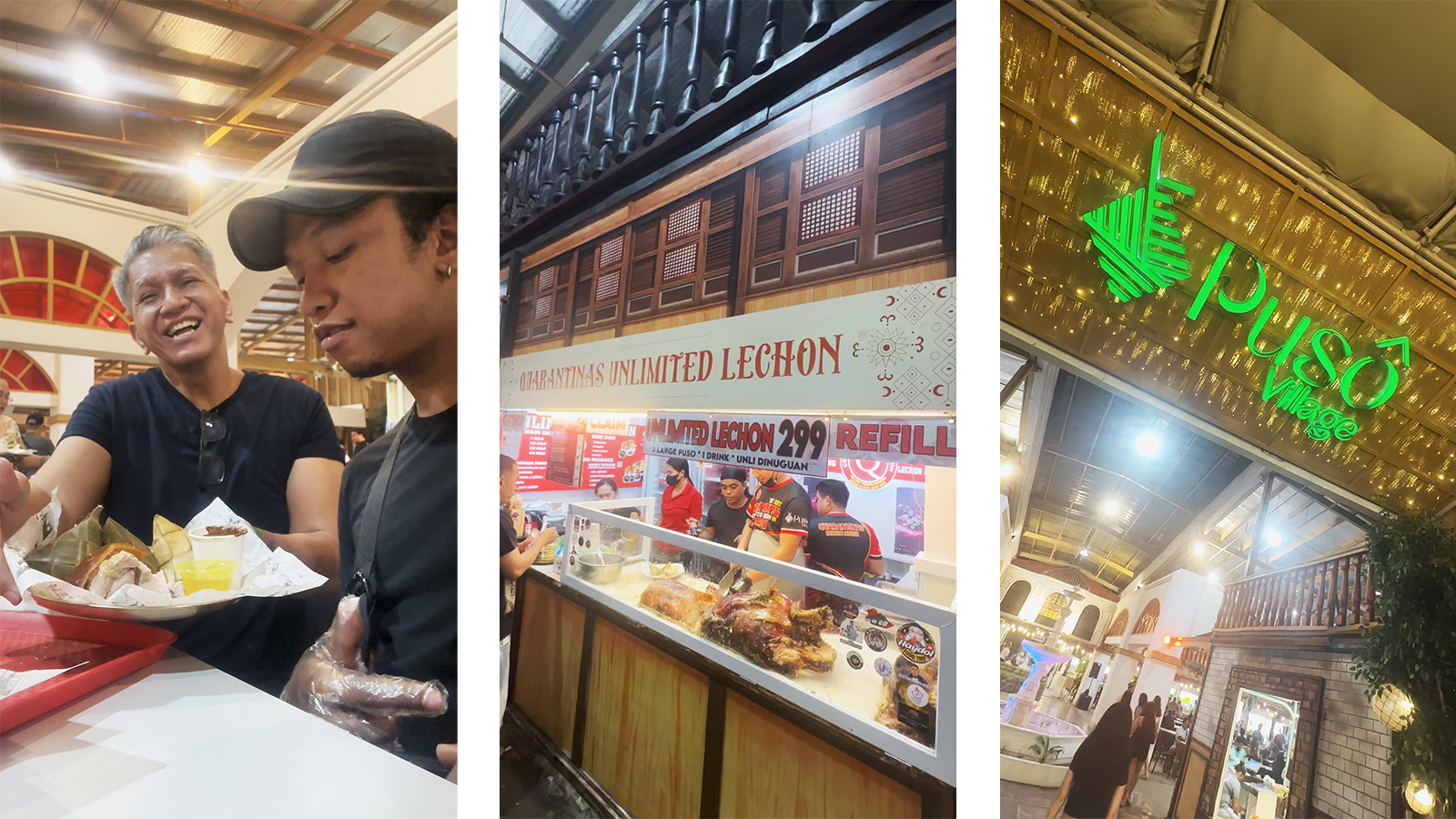
Una, developed by Cebu2World/Megawide as part of the Carbon Market modernization, this place’s name drew inspiration from the pusô rice cake that’s served when you have meals in Cebu. There are, therefore, design elements that’d remind you of the pusô – e.g. those octahedral shapes on the entrance. Inside, there are attempts to beautify by borrowing elements from Bahay na bato Philippine architectural style; most are fake, though, such as those painted-on verandahs you’d see when you look up.
Ikalawa, there are over 100 food stalls and retail outlets here… though more of the former than the latter. They’ve been “properly” structured, so that the lechon vendors are on one side, seafood sellers on another side, and so on.
Ikatlo, we tried some of the offerings to ascertain how good they are.
The unlimited lechon is popular, providing an opportunity particularly for non-locals to cheaply enjoy this Cebuano treat. Taste-wise, the lechons vary little, some saltier than the others. The “approach” in serving is similar, though. You get an okay portion when first served, and the portion gets smaller the more you return. Noticeably, by the third refill, the vendors become grumpier when serving you, some even ignoring you, or stuffing fatty parts on your plate. Business greed in action.
Though cooked the same way (i.e. buttered), the seafood platters are inconsistent. You could get some shrimps or crabs now and then, though most times, you’d just get mussels.
Then there’s the tuslob-buwa, pig’s brain cooked under maximum heat to then become dip for pusô. We’d say this is acquired taste… but there’s not much to taste. So this is a costly to-try food.
Only open until 10.00PM, Pusô Village offers those in Cebu a venue to try as many of the local goods as possible. For that, alone, this is a must-check. You are sure to find a few stuffs you’d like.
But the city still has a lot of venues offering local culinary and cultural goods, and they deserve to be also checked. And so off we go for more LGBTQIA+ rampa…
Pusô Village is located at M.L Quezon Blvd., Sto. Nino, Cebu City.
Destinations
Going Chinese in Pulilan, Bulacan
Craving for #chinesefood in #Bulacan? We tried the offerings of Lee Foo Panciteria #Pulilan, and we’re on the fence here (yes if no choice, no if you can go elsewhere).
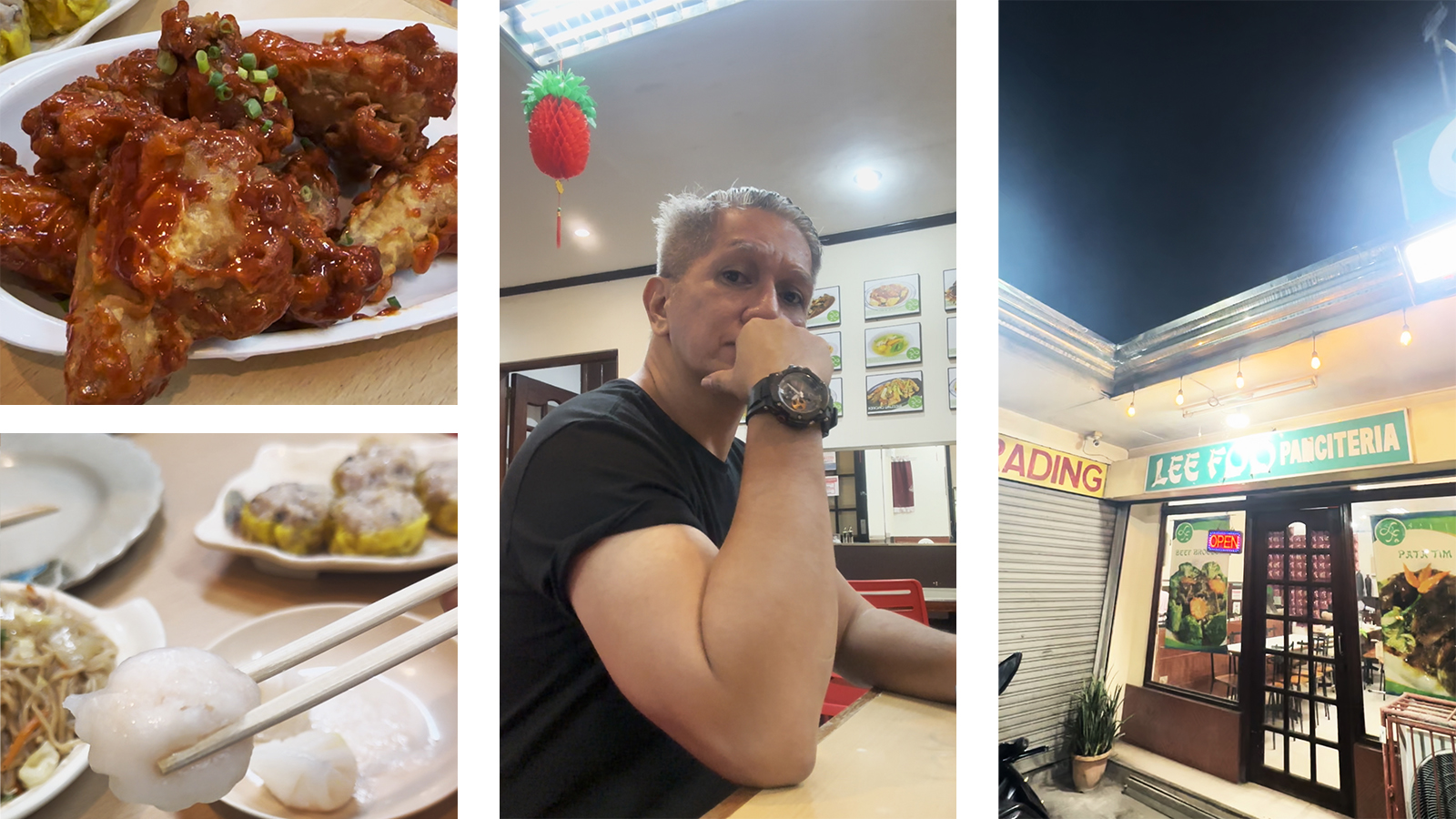
We happened to be in Pulilan in Bulacan, and I had pancit craving. As if on cue, we passed by Lee Foo Panciteria Pulilan, which – after we Google-checked – is supposedly one of the more frequently-visited Chinese restos in these parts of the province, so… of course we checked.
@outragemag Craving for #chinesefood in #Bulacan? We tried the offerings of Lee Foo Panciteria #Pulilan ♬ original sound – Outrage Magazine
Una, this place is really, REALLY easy to find. Located along the Pulilan Regional Road in Barangay Cut-cot in Pulilan, this is right in the middle of the municipality.
Ikalawa, the resto is actually divided into three parts: one side is for those with reservations, another part is for walk-in diners, and another part is for events. If/when the resto isn’t full, only the main part (middle one) is kept open.
No, this isn’t some fancy resto. More like an airconditioned karinderya, complete with wooden tables and plastic chairs. Look-wise, it wasn’t dirty naman when we were there, so that’s a plus.
Ikatlo, the workers were friendly naman… and they moved fast – e.g. while waiting for our orders, we were given must-check peanuts, and since we finished what we got fast, our waitress was more than happy to accommodate us.
Ika-apat, now… how was the food?
The house specialty, the Lee Foo Chicken (₱265 for half, ₱495 for whole), looked like fried chicken with ketchup. Okay… the breading was okay since it didn’t overpower the meat. The chicken, too, was properly cooked, and it wasn’t dry. But it was tasteless overall; so the ketchup taste is what stays with you.
The Pancit Canton Bihon (₱255) had thin pancit noodles, almost as thin as the bihon. It didn’t have lots of sahog; instead, you’d notice the extenders (like kikiam, and so on). I like good pancit, I swear… but this isn’t one of them, sorry.
The weirdly-wrapped Hakaw (₱155) was small, so it was bitin.
And then there’s the Siomai Steam (₱155), which was, in a word, weird. The size was good, similar to those ₱10 siomais. But the way this was prepared was weird for us – e.g. like the meat was overwatered, and having a hard time staying solid, so that it was smudgy, and disintegrated in the mouth even without chewing. I suppose that, at least, it wasn’t disgusting taste-wise.
Lee Foo Panciteria Pulilan is, we believe, popular. Like President in Chinatown, or a branch of David’s in some mall. To each his or her own nga naman. But for us, we’re off to look for other Chinese restos na muna as we head out in search of more lafangan venues.
Lee Foo Panciteria Pulilan is located at 159 Barangay Cut-cot, Pulilan, 3005 Bulacan Province. For more information, contact 0925 800 0168, or email leefoopanciteria@yahoo.com.

Study links coffee consumption to metabolic health and sex hormones

Manulife Investments Philippines leads UITF rankings across equity and fixed income funds

Scheduling dental care during prenatal visits boosts oral health care during pregnancy

Enjoying the grilling at Mandaue City’s Matias BBQ

Dogs can distinguish between human fear and sadness

Pet dog microbiota may protect young children from respiratory tract infections and reduce the need for antibiotic courses

Walking and weight training alone are not enough for strong bones – football and handball may be more effective

Keeping kitty indoors is not the cat-astrophe that owners fear

Why a UTI hurts — and why that might be a good thing

Pregnancy complications can signal heart disease risk years before traditional screening, study finds

Filipinos prioritize independence as legacy for longer lives

Going Chinese in Pulilan, Bulacan

Eating out in Cebu in one place via Pusô Village
Pregnancy complications can signal heart disease risk years before traditional screening, study finds
Why a UTI hurts — and why that might be a good thing

Posture can influence your mood and behavior, study suggests
Walking and weight training alone are not enough for strong bones – football and handball may be more effective
Dogs can distinguish between human fear and sadness
Scheduling dental care during prenatal visits boosts oral health care during pregnancy
Pet dog microbiota may protect young children from respiratory tract infections and reduce the need for antibiotic courses

-
 NewsMakers4 weeks ago
Filipinos prioritize independence as legacy for longer lives
-
 Destinations4 weeks ago
Going Chinese in Pulilan, Bulacan
-
 Destinations3 weeks ago
Eating out in Cebu in one place via Pusô Village
-
 NewsMakers3 weeks ago
Pregnancy complications can signal heart disease risk years before traditional screening, study finds
-
 NewsMakers3 weeks ago
Why a UTI hurts — and why that might be a good thing
-
 NewsMakers3 weeks ago
Posture can influence your mood and behavior, study suggests
-
 Wellness3 weeks ago
Walking and weight training alone are not enough for strong bones – football and handball may be more effective
-
 Pet Care2 weeks ago
Dogs can distinguish between human fear and sadness