
NewsMakers
Beauty soaps that will make you feel fresh and new every day

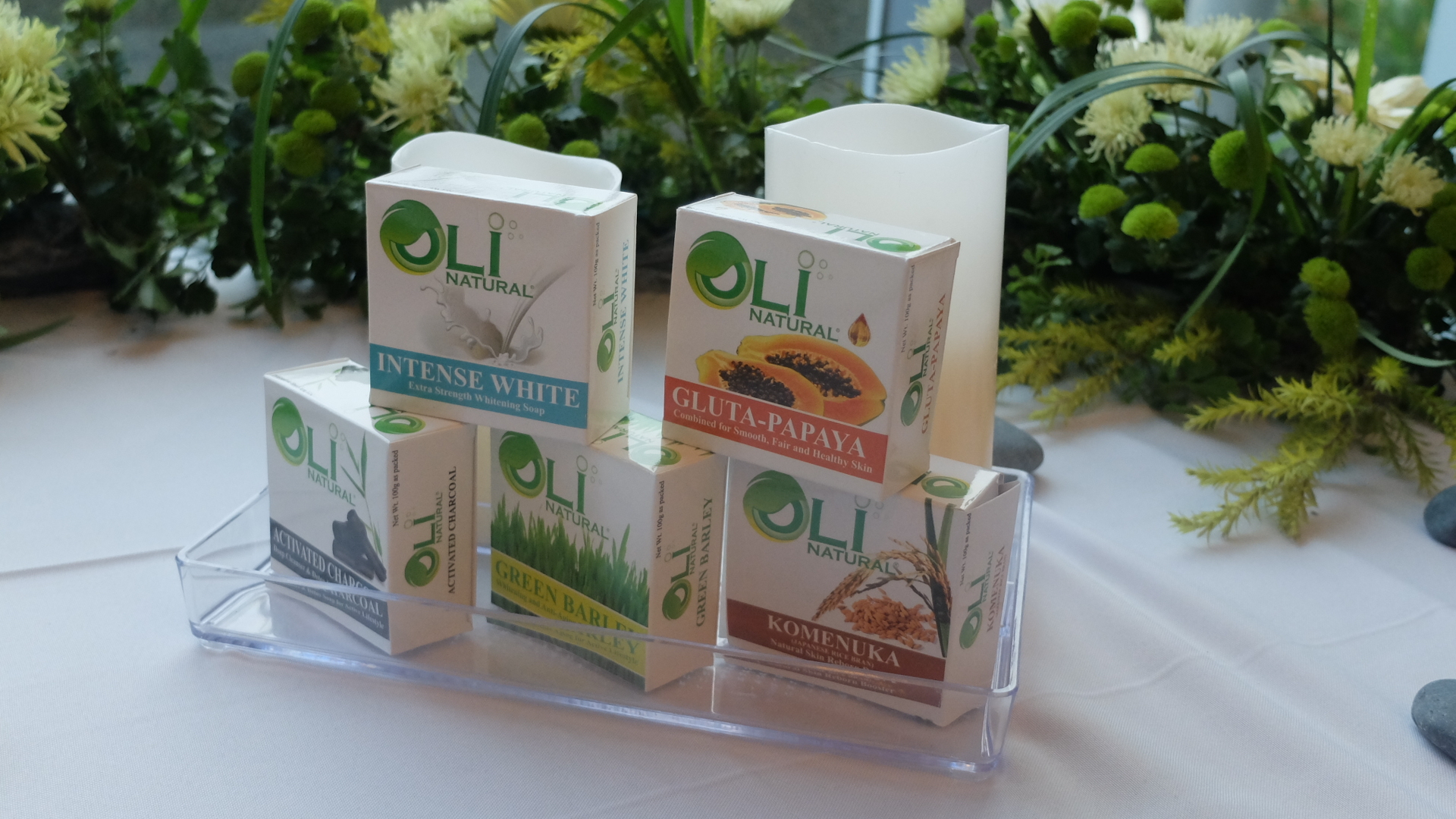
ACTIVO Global, Inc., a consumer company, has formally introduced to the market its line of Oli Natural whitening beauty soaps that are primarily made up of coconut oil, known for its high moisture content and rich lather.
The Oli Natural line includes five variants: Gluta Papaya for moisturizing; Green Barley, which has anti-aging properties and helps achieve an odor-free day; Activated Charcoal for deep cleansing and detox; Intense White for extra strength whitening; and soon-to-be available, Komenuka for natural booster of healthy skin.
The Oli Natural line includes five variants: Gluta Papaya for moisturizing; Green Barley, which has anti-aging properties and helps achieve an odor-free day; Activated Charcoal for deep cleansing and detox; Intense White for extra strength whitening; and soon-to-be available, Komenuka for natural booster of healthy skin. PHOTO: MELBA BERNAD
“We are confident in saying that each of our soap is made from coconut oil,” says Jerry Foz Sesmundo, President and Chief Executive Officer of Activo Global. Sesmundo developed the Oli Natural brand in 2014 as a result of his search for a skincare product that is centered on consumer satisfaction.
“Oli Natural soaps are what we call ‘real’ soaps because they are not just for keeping the skin clean. Unlike other brands that leave your skin dry and stripped of its natural oils, Oli Natural moisturizes and conditions your skin to bring out the new you.”
The company takes pride in the fact that the soaps, all five of them, are cold-processed so the active properties of its natural ingredients remain intact and benefit those who will use the product. More importantly, cold-processed soaps bring more value to your money because they are carefully formulated and hand-made by batches while hot processed soaps are mass produced and made in a very economical manner, compromising its value and quality.
The Gluta Papaya has primarily coconut oil, glutathione, papaine enzymes, and carrot extract. This variant improves the texture, whitens, moisturizes and protects the skin from pollution.
Green Barley rich in anti-oxidant, is mainly made up of coconut oil, shea butter, kojic acid, Vitamin C, and green barley extract. The Green Barlely also nourishes and repairs the skin and cures skin problems such as itchiness, blemishes, and acne.
Bamboo wood charcoal is the main ingredient of Activated Charcoal variant added with lactic acid, Vitamin C, and a combination of extracts. It cleanses, exfoliates, and removes the harmful substances for a clearer and healthier skin.
The Intense White soap has rice bran oil, arbutin, cucumber extract, salicylic acid, among others. This variant lightens, remove dead skin cells, and prevents the appearance of freckles and age spots, and hyper-pigmentation.
Komenuka is made up of Japanese rice bran, which is rich with nutritional values. It is combined with other ingredients to nourish, soothe, hydrate, and promote the natural regeneration of the skin.

To help promote the Oli Natural line, Activo has chosen a couple of young celebrities to help endorse the soaps: Kristine Sablan (left) and Raven Molina (right). In the photo with them is Jerry Foz Sesmundo, President and Chief Executive Officer of Activo Global. PHOTO: MELBA BERNAD
To help promote the Oli Natural line, Activo has chosen a couple of young celebrities to help endorse the soaps. Kristine Sablan is a model and a bidding Star Magic actress, while Raven Molina is a basketball enthusiast turned model who dreams of becoming an actor some day. He has appeared in several TV commercials, print ads, and runway shows.


Beauty & Fashion
Redefining aesthetics: From anti-aging to healthy aging
Growing attention is now being given to healthy aging, understanding how the entire face changes over time, preserving facial harmony, and helping people continue to look like themselves.


For decades, “anti-aging” has defined the beauty and aesthetics conversation, promising to erase wrinkles and reverse the signs of time. Today, that conversation is shifting.
Aging is no longer just about looking younger. Growing attention is now being given to healthy aging, understanding how the entire face changes over time, preserving facial harmony, and helping people continue to look like themselves.
A review published in Facial Plastic Surgery, The Anatomy of the Aging Face: A Review, describes aging as changes across bone, ligaments, muscles, fat, and skin. Another review in Aesthetic Surgery Journal, The Facial Aging Process From the “Inside Out”, explains how changes beneath the surface eventually become visible on top.
Studies in Plastic and Reconstructive Surgery show facial fat is organized into distinct anatomical compartments that can lose volume and shift position over time, altering facial shape and balance.
For multi-awarded aesthetic physician Dr. James Co, founder of Cosma Institute and Architect of Aesthetic Confidence, these findings are the reason aesthetic care must start with understanding, not just treating.
“Aging is not a disease we need to cure,” Co said. “It is a biological process. As physicians, our role is to understand what is changing beneath the surface, how those changes differ from person to person, and whether intervention is appropriate in the first place.”
“When you only look at the wrinkle, you are looking at the surface of a much bigger anatomical process,” he added. “The face ages as a system. Good assessment means understanding what is happening underneath before deciding what should be done on the surface.”
Part of that understanding is recognizing that no two faces age the same way. Two people can be the same age and experience aging very differently. Genetics, skeletal structure, fat distribution, skin characteristics, sun exposure, lifestyle, and environmental factors all influence how aging presents.
“Two patients can be the same age and come to me with completely different anatomy, lifestyles, concerns, and goals,” Co said. “Why would we expect their treatment plans to look exactly the same?”
This is where healthy aging broadens the conversation — from fixing isolated signs to looking at the face as a whole and listening to what the individual actually wants.
“Someone can want to look refreshed without wanting to look 20 years younger,” Co said. “Those are completely different goals.”
Rather than trying to freeze one version of the face forever, healthy aging acknowledges that the face will continue to change. As different structures change at different rates, the relationship between features evolves. Facial harmony is therefore not fixed.
“You cannot freeze one version of your face forever,” Co said. “But you can understand how the face is changing and make decisions that respect its natural proportions and your identity.”
In the age of social media, where aesthetic treatments are highly visible, Co cautions against self-diagnosis.
“Patients should not have to diagnose themselves from social media,” he said. “You might recognize a concern, but deciding why it is happening and what should be done about it requires proper assessment.”
The shift is also about how people feel, not just how they look. A 2022 review on minimally invasive facial aesthetic procedures found studies are increasingly looking beyond physical changes to include satisfaction with appearance and aspects of psychological and social well-being, while noting that evidence still needs careful interpretation.
For Co, this reinforces that success is not always about looking dramatically younger.
“We need to ask whether the result makes sense for the patient, whether expectations were met, and whether we preserved the things that make that person recognizable,” he said. “I would rather someone tell my patient, ‘You look well,’ than immediately ask, ‘What did you have done?'”
At Cosma Institute, Co applies this consultation-led philosophy through individualized assessment, facial harmony, medical judgment, and patient education. Having trained aesthetic practitioners across Southeast Asia and Europe, he advocates for natural-looking outcomes that respect the characteristics already present in each face — an approach that recently earned him two awards at the Merz Aesthetics Tala Awards.
For Co, the evolution of aesthetic medicine is not about having more tools, but knowing when to use them — and when not to.
“Aging cannot be stopped, and I don’t think that should be the promise,” he said. “What we can do is understand it better. We can look at the science, understand the anatomy, listen to the patient, and make decisions that allow them to age while still looking recognizably like themselves.”
For Co, healthy aging begins not with fighting age, but with understanding it.
NewsMakers
The look and feel of your neighborhood may affect your sleep
Those living in neighborhoods rated as having a stronger sense of safety tended to sleep longer, and that this rating appeared to be shaped by the streetscape.


Your neighborhood’s “streetscape”—the physical environment of your street—is something that you have probably never consciously thought about, despite seeing it every day. But what if the streetscape was affecting you on a subconscious level and disrupting your sleep?
This intriguing question is posed by the findings of a study led by Professor Daisuke Matsushita of the Graduate School of Human Life and Ecology at Osaka Metropolitan University. The research team used AI to analyze more than 200,000 Google Street View images to identify visual neighborhood characteristics. They then linked these characteristics to the self-reported sleep of 1,089 working adults living on the lower floors of apartments in Tokyo, who were most likely to be affected by the streetscape.
They found that those living in neighborhoods rated as having a stronger sense of safety tended to sleep longer, and that this rating appeared to be shaped by the streetscape. Generally, people slept longer in areas with lots of greenery, such as leafy trees, on the street. Similarly, high “enclosure”—meaning many tall vertical buildings and few wide-open spaces—was also associated with longer sleep and fewer insomnia symptoms.
However, the study also made a surprising finding. The researchers found that highly walkable streetscapes, such as those with more sidewalks and traffic signs, were associated with a lowered sense of safety and shortened sleep duration.
This suggests that walkability does not always represent a reassuring environment. Instead, a possible explanation is that streets with extensive pedestrian infrastructure are often busier, more crowded, and used by more strangers, which may be perceived as less safe or less relaxing than quieter residential streets.
“This study demonstrates the potential for evaluating streetscape characteristics across large geographic areas in a cost-effective manner,” Dr. Matsushita said. “Based on the technique used in this study, cities could potentially measure perceived safety, beauty, liveliness, and enclosure as well as pollution and noise.”
“We hope that opening up this new perspective creates further possibilities for designing healthier neighborhoods,” he concludes.
The findings were published in Building and Environment.
NewsMakers
Workout or nap? Either can help your sleepless brain, study finds
People who either completed 20 minutes of moderate-to-vigorous exercise or took a 90-minute nap performed about 22 per cent better on memory tests after 30 hours without sleep than those who did neither.

A short workout or a nap can help protect memory after a sleepless night, a McGill University-led study has found.
Researchers found people who either completed 20 minutes of moderate-to-vigorous exercise or took a 90-minute nap performed about 22 per cent better on memory tests after 30 hours without sleep than those who did neither. The findings, published in Proceedings of the National Academy of Sciences (PNAS), point to practical ways to counter the effects of sleep deprivation.
“Sleep loss affects nearly every aspect of how we think and function, but many people can’t simply stop what they’re doing and get more sleep,” said senior author Marc Roig, Professor in McGill’s School of Physical and Occupational Therapy. “Our findings show that even a brief bout of exercise may help preserve one of our most important cognitive abilities.”
The study involved 54 healthy young adults who stayed awake for 30 consecutive hours under lab supervision. Participants were then assigned to one of three groups: a 20-minute cycling session, a 90-minute nap or a control condition. Three days later, researchers tested their memory for images they had viewed immediately after the intervention. Those who exercised or napped remembered significantly more images than participants who did neither.
Same result, different pathways
While the memory benefits were nearly identical, brain recordings revealed that exercise and napping helped in different ways.
Napping appeared to help the brain recharge, making it easier to take in and remember new information. Exercise, by contrast, helped the brain use its remaining resources more efficiently, without making participants feel more tired.
The findings could eventually inform fatigue-management strategies in workplaces where sleep loss is common and mistakes can have serious consequences, such as health care, transportation and emergency response.
“A nap isn’t always possible in the middle of a shift,” said first author Madhura Lotlikar, a doctoral candidate in McGill’s Department of Neurology and Neurosurgery. “Exercise is accessible, inexpensive and easy to implement. That makes it a promising tool to help people stay cognitively sharp when sleep is limited.”
The researchers emphasize that exercise cannot replace sleep, but it may help people function better when getting enough rest isn’t possible.
About the study
“Protecting episodic memory after sleep loss: Similar benefits of exercise and naps via distinct neural contributions” by Madhura Lotlikar and Marc Roig et al., was published in Proceedings of the National Academy of Sciences of the United States of America.

Redefining aesthetics: From anti-aging to healthy aging

Visiting San Pablo City’s Pho Viet Nam

Four to six servings of wholegrain per day lowers risk factors for heart disease

Structured exercise linked to longer cancer survival and time free of disease

Heading to Pila, Laguna? Check out La Cosina Antonio

Pasalubong shopping in Davao via Aldevinco

The look and feel of your neighborhood may affect your sleep

Workout or nap? Either can help your sleepless brain, study finds

Study links coffee consumption to metabolic health and sex hormones

Manulife Investments Philippines leads UITF rankings across equity and fixed income funds
Pasalubong shopping in Davao via Aldevinco
Structured exercise linked to longer cancer survival and time free of disease
Heading to Pila, Laguna? Check out La Cosina Antonio
Four to six servings of wholegrain per day lowers risk factors for heart disease
Visiting San Pablo City’s Pho Viet Nam
Redefining aesthetics: From anti-aging to healthy aging

-
 Destinations4 weeks ago
Pasalubong shopping in Davao via Aldevinco
-
 Wellness2 weeks ago
Structured exercise linked to longer cancer survival and time free of disease
-
 Destinations3 weeks ago
Heading to Pila, Laguna? Check out La Cosina Antonio
-
 Nutrition2 weeks ago
Four to six servings of wholegrain per day lowers risk factors for heart disease
-
 Destinations1 week ago
Visiting San Pablo City’s Pho Viet Nam
-
 Beauty & Fashion4 days ago
Redefining aesthetics: From anti-aging to healthy aging