
Destinations
Waiting for tuna in Albay
Today, about 52% of the country’s fish exports come from tuna, which buoys the lives and livelihoods of millions of Filipinos. WWF’s Global Oceans Campaign, Sustain Our Seas, builds on decades of work to rekindle the health and productivity of the Earth’s oceans.


By Gregg Yan

A little boy admires his family boat’s sigil – a jumping Bankulis or Yellowfin Tuna. The boy’s future might very well depend on whether these oceanic giants keep on jumping.
PHOTO COURTESY OF WWF-PHILIPPINES
Late afternoon and we’re holed up in a hut along the coast of Tiwi in Albay, trading fish tales and waiting for fishermen to return. Sitting around us are their wives, mending nets and eyeing the swelling crowd of kids cajoling in the surf. It is June, the season for yellowfin tuna.
The first of the bancas arrive, unloading a decent haul of pundahan or skipjack – small, striped tuna which have proven surprisingly resilient to commercial fishing. Bancas two and three return empty-handed while a fourth disgorges a tub of galunggong or scad. Just one bankulis or yellowfin tuna has been landed, hours earlier. She tipped the scales at 39 kilograms, golden sickle-fins resplendent even in death. We wait until the sun dips into the sea, but no more tuna come.
“The Lagonoy Gulf is the Bicol region’s richest tuna site – but it is heavily overfished,” explains BFAR National Stock Assessment project head Virginia Olaño. “Two decades ago, fishers regularly caught large yellowfin. In 1998, a fisherman landed a 196 kilogram giant, long as a car and fat as a drum. Now yields are waning and yellowfin average just 18 to 35 kilograms – meaning juveniles have replaced adults.”
Though yellowfin tuna are highly-prized, they are far more than mere seafood. Top predators in the marine food chain, they maintain the balance between oceanic predators and prey. “Today the Lagonoy Gulf’s most common fish are anchovies,” warns Olaño. “There aren’t enough predators to eat them – because we’ve eaten most of their predators.”
To stop overfishing and help manage existing tuna stocks in Bicol, the World Wide Fund for Nature (WWF), Bureau of Fisheries and Aquatic Resources (BFAR), plus the Philippine Council for Agriculture and Fisheries (PCAF) convened the first meeting of the Gulf of Lagonoy Tuna Fishers Federation (GLTFF), comprised of the coastal municipalities ringing the Lagonoy Gulf – 3070-square kilometers of sea separating the Bicol mainland from the storm-swept island of Catanduanes. Over 500 people attended Bicol’s first large-scale gathering of fishers, held at the Lagman Auditorium of Bicol University’s Tabaco Campus.
“We’ve waited three years to formalize this federation, which covers 2000 tuna fishers in the Lagonoy Gulf,” says BFAR Assistant Regional Director Marjurie Grutas. “GLTFF aims to synergize fisheries management while optimizing cooperation, knowledge-sharing and enforcement. We aim to eliminate illegal fishing, minimize the capture of juvenile tuna and drive commercial fishers away from municipal waters – the three leading causes of overfishing.”
Since 2011, WWF has been working to enhance yellowfin tuna management practices for 5000 fishers in 112 tuna fishing villages around the Lagonoy Gulf and the coast of Occidental Mindoro.
WWF’s Public Private Partnership Programme Towards Sustainable Tuna (PPTST) has since organized tuna fishing associations in all 15 municipalities in the Lagonoy Gulf, plus six LGUs in the Mindoro Strait. It spearheaded the registration and licensing of tuna fishers, vessels and gear to minimize bycatch and illegal fishing, deployed 1000 plastic tuna tags to make the fishery traceable, and completed a series of training sessions on proper tuna handling to ensure that exported tuna continually meet international quality standards.
PPTST harnesses market power and consumer demand to promote sustainably-caught tuna and support low-impact fishing methods like artisanal fishing with hand-line reels – better alternatives to commercial tuna long-lines, which stretch up to 80 kilometers and are rigged with up to 3000 baited hooks.
Funded by Coop, Bell Seafood, Seafresh and the German Investment and Development Corporation, PPTST involves European seafood companies plus their local suppliers, BFAR, local government units in the Bicol Region and Mindoro, the WWF Coral Triangle Program, WWF-Germany plus WWF-Philippines.
Today, about 52% of the country’s fish exports come from tuna, which buoys the lives and livelihoods of millions of Filipinos. WWF’s Global Oceans Campaign, Sustain Our Seas, builds on decades of work to rekindle the health and productivity of the Earth’s oceans.
“Federations like GLTFF are the resource management systems of the future,” concludes WWF-Philippines president and CEO Joel Palma while sampling maguro sashimi (thinly-cut tuna slices) sourced from the sole 39 kilogram yellowfin landed in Tiwi.
Savoring sashimi, I hope that by working to conserve their shared resource, Lagonoy Gulf’s fishers might someday herald the return of the giant bankulis. Now that fish tale should be worth the wait.

A fisherman shows off a colorful squid lure, used to entice large pelagic predators to bite.
A plethora of makeshift items – from dyed feathers and rubber squid to shredded plastic bags – are used to attract and catch tuna, billfish and mackerel.
Each fisher has his own formula: “I use a combination of rubber squid and shredded plastic lures, but my real secret is squid ink, which I tie-off in tiny plastic bags. As the lure moves, the squid ink squirts out. Fish find this irresistible,” shares Miguel Borres, a grizzled veteran.
Though gear has evolved, many fishers still rely on age-old techniques to collect their quarry.
PHOTO COURTESY OF WWF-PHILIPPINES

Yellowfin Tuna are so-named because of their canary yellow fins and finlets.
The torpedo-shaped fish have clocked in speeds of 75 kilometers per hour – almost TWICE the speed of the world’s fastest person, Usain Bolt!
PHOTO COURTESY OF WWF-PHILIPPINES

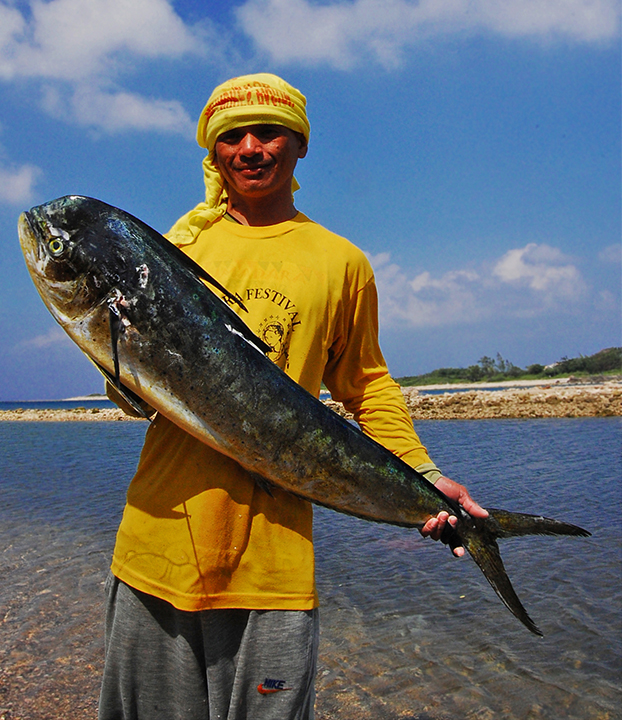
The most sought-after fish in Bicol’s Lagonoy Gulf is the Yellowfin Tuna. A fisher shows off a handsome 39-kilogramme fish.
Two decades ago, fishers caught a 196-kilogramme Yellowfin – the largest caught in the Gulf.
Classified by the International Union for the Conservation of Nature (IUCN) as near threatened, Yellowfin Tuna sport metallic blue backs, golden flanks and a silver belly. Sickle-shaped dorsal and anal fins, hued bright yellow, grant them their name.
They form schools with other tuna species and sometimes with dolphins. While most fish have white flesh, tuna tissue hosts loads of myoglobin, which efficiently oxygenates their systems to give tuna meat a distinctive red hue and mouth-watering texture. This is why they’re so highly sought after.
WWF works to conserve tuna stocks in the Philippines through its Partnership Programme Towards Sustainable Tuna (PPTST) project.
PHOTO COURTESY OF WWF-PHILIPPINES

Smaller fish such as scad and mackerel comprise the majority of fishers’ subsistence hauls.
PHOTO COURTESY OF WWF-PHILIPPINES
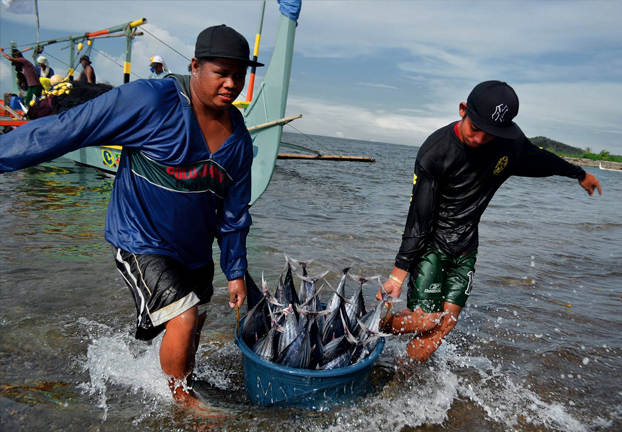
A fisherman rests after unloading his craft’s catch.
Thousands fish under the shadow of Mayon Volcano, whose rich volcanic nutrients fuel blooms of plankton – the essential base of the marine food pyramid.
PHOTO COURTESY OF WWF-PHILIPPINES




Destinations
Finding beauty, and not just of faith, at the Bangor Cathedral
Seeking #LGBT #faith or beauty in #Wales? Check out the #Bangor Cathedral in #Gwynedd.


A common practice among many Pinoy travelers is to visit a church, preferably Roman Catholic, in new places visited. Here’s the thing when you’re in the United Kingdom: it’s harder than you think because, while Catholics do exist, many of the churches here are of the Church of England/Anglican.
On one hand, without intending to gaslight, I often joke that it’s not like you’re praying to different gods (LOL).
But on the other hand, actually dropping by these churches can be eye-opening. Not just to faith, but seeing beauty in their richness… in history, architecture, and so on…
At least this is what was gleaned in the Bangor Cathedral in Wales.
@outragemag Seeking #LGBT #faith or beauty in #Wales? Check out the #Bangor Cathedral in #Gwynedd ♬ original sound – Outrage Magazine
Una, if you’re in Gwynedd, this is very accessible. It’s there, in the middle of the oldest city in Wales. But if you’re from elsewhere, you need to travel to the city that’s over three hours away from London.
Ikalawa, this is formally St. Deiniol’s Cathedral, which has been used since about the 6th century.
As FYI: St. Deiniol, the 6th-century Welsh saint, wasn’t “made” a saint through the Roman Catholic canonization process. In the olden times, Welsh/Celtic Christian holy figures were usually recognized by local church tradition, reputation for holiness, and their role as founders/abbots/bishops, rather than by a formal Vatican procedure. In the case of Deiniol, he founded the monastery/church at Bangor around 525, so that over time, he was venerated as Saint Deiniol.
Ikatlo, what to see there?
Architecturally, it’s a mix of Norman/Romanesque and Gothic. It does feel medieval… and grandly so.
Inside, you’d see a layered medieval–Victorian Gothic interior, apparent in the stone arches, choir stalls, stained glass, and so on.
Those stained glasses, let’s emphasize, are from the 19th- and early-20th-century, including works by Clayton & Bell, James Powell & Sons, Burlison & Grylls, and Mayer & Co.
Should you seek this one out? Deserving ba na sadyain? Kung nasa area ka na, keri. Welcoming naman ang church.
Otherwise… rampa elsewhere na, as I do sa patuloy na LGBTQIA+ wandering…
Destinations
Checking Llanfair PG, the town that’s long in name and not much else
Introducing #llanfairpwllgwnyngyllgogerychwyrn or #llanfairpg, the town with the longest name in #Europe, as discovered during this #LGBT #Wales trip.

When in Wales, one of the must-check places – at least based on tourist recommendations – is this Anglesey town famous for its very long name:the Llanfairpwllgwyngyll, located across the Menai Strait, a short drive or train ride from Bangor.
How’s the place?
@outragemag Introducing #llanfairpwllgwnyngyllgogerychwyrn #llanfairpg, the town with the longest name in #Europe, as discovered during this #LGBT #Wales ♬ original sound – Outrage Magazine
Una, let’s get one thing out of the way: Don’t come here expecting to see or do much. People just come here to take pics of the town’s name… basically.
The name is the one, if not the only attraction.
As FYI: Even locals have a hard time pronouncing the name. We asked someone to do that for us. We were told, though, that there’s a shortened version, Llanfair PG… which isn’t a mouthful na.
Ikalawa, the name was popularized in the 19th century, mainly as a publicity stunt. The town, of course, supersedes this popularized name.
Ikatlo, the name is usually translated to: St. Mary’s Church in the hollow of the white hazel near a rapid whirlpool and the Church of St. Tysilio near the red cave.
The meaning actually revolves around local landmarks, including:
- St Mary’s church,
- the “Swellies” (the pool/hollow of the whirlpool in the Menai Strait)
- St Tysilio’s church
Ika-apat, in truth, this isn’t the longest name for any place. Even Bangkok’s ceremonial name is longer. Then there’s that town in New Zealand.
But this is commonly described as the longest one-word place name in Europe.
So… since the name was crafted for tourism, exactly how many tourists come over? Roughly 200,000 a year. Doesn’t seem much, really, but considering the “offerings” of the place, marami na.
Besides, compared to the tourist numbers under the Marcos administration, marami na yan (!).
But off we go for more LGBTQIA+ rampa…
Destinations
Underground discovery: From Heathrow, commute using the Underground to reach central London
You arrive in Heathrow, the main airport in London, and – like many tourists – you need to head to the center of London for your accommodation. You have many options, like catching a taxi. But you can just take the “regular” train, the so-called Underground.

So… you arrive in Heathrow, the main airport in London, and – like many tourists – you need to head to the center of London for your accommodation. There are, of course, a number of transportation options, from grabbing a cab to taking the express train.
There’s an option that isn’t always advertised: that is, for you to just take the “regular” train, the so-called Underground.
Special thanks to Ms Kayla Garcia for this tip, of course.
@outragemag New to #London and traveling from #Heathrow to the city center? No need to overspend via #taxi or #expresstrain; just take the #LGBT #Underground ♬ original sound – Outrage Magazine
Una, the underground is, as the name suggests, underground. From the arrival area, follow the signs leading to the “Underground”, which is around five minutes walk from where you’d exit after collecting your luggage.
Ikalawa, be careful: it’s basically on the same area as the Express trains, so if you erroneously entered their area, you’d be forced to spend more.
Ikatlo, yung bayad, nagbabago depending sa exact location you’re going to, and time, too. But naglalaro lang sa 6 pounds pababa… usually. Which is much cheaper than the Express trains by a lot. Add na lang to shopping ang natipid… unless anak ka ng politician na male-maletang pera ang dala mo while undergoing your tax-funded UK education…
And ika-apat, you may buy tickets from those machines at the entrance of the station. But this is London, cashless is usual. Pay using PayWave; tap mo lang credit or debit card mo, keri ka na.
Kung rich ka and money is not a problem… avail ka ng less local mode of transportation, kaya mo yan. But for those who believe commercialization of service sucks, and – in the case of transportation – bettering public transport makes better sense than shelling out cash to make rich people in the transportation industry even richer, then… here’s how many locals travel to and from Heathrow. Huwag na pretentious and avail na…
And off we go for more LGBTQIA+ rampa…

Finding beauty, and not just of faith, at the Bangor Cathedral

Checking Llanfair PG, the town that’s long in name and not much else

Underground discovery: From Heathrow, commute using the Underground to reach central London

Sun Life appoints Bianca Ilibasic as Managing Director, Sun Life Global Solutions

Living with cats does not worsen asthma in children, suggests study

Off to Bulacan only to be underwhelmed (and stressed) at The Beef Deli-Malolos

Manulife continues legacy of service in PH with Impact Week 2026

Could your oral health be affecting fertility?

Maintaining a healthy heart may require regular doses of positivity

Checking the historic Charlie wanton resto in Mandaluyong
Off to Bulacan only to be underwhelmed (and stressed) at The Beef Deli-Malolos
Checking the historic Charlie wanton resto in Mandaluyong
Maintaining a healthy heart may require regular doses of positivity
Could your oral health be affecting fertility?
Underground discovery: From Heathrow, commute using the Underground to reach central London
Manulife continues legacy of service in PH with Impact Week 2026
Sun Life appoints Bianca Ilibasic as Managing Director, Sun Life Global Solutions
Living with cats does not worsen asthma in children, suggests study
Checking Llanfair PG, the town that’s long in name and not much else
Finding beauty, and not just of faith, at the Bangor Cathedral

-
 Destinations3 weeks ago
Off to Bulacan only to be underwhelmed (and stressed) at The Beef Deli-Malolos
-
 Destinations4 weeks ago
Checking the historic Charlie wanton resto in Mandaluyong
-
 NewsMakers4 weeks ago
Maintaining a healthy heart may require regular doses of positivity
-
 NewsMakers4 weeks ago
Could your oral health be affecting fertility?
-
 Destinations2 weeks ago
Underground discovery: From Heathrow, commute using the Underground to reach central London
-
 Product Showcase4 weeks ago
Manulife continues legacy of service in PH with Impact Week 2026
-
 Product Showcase2 weeks ago
Sun Life appoints Bianca Ilibasic as Managing Director, Sun Life Global Solutions
-
 Pet Care2 weeks ago
Living with cats does not worsen asthma in children, suggests study