
Travel
3 Ways to save Nemo and Dory
With the release of Finding Dory this 17 June, a global spike in marine aquarium fish demand is expected. The Philippines and Indonesia are the world’s top exporters of wild-caught marine fish, supplying 85% of the trade – so Pinoy fishers will soon be scouring reefs for Nemo, Dory and all their finned friends. What can we do to protect them?


By Gregg Yan
Best Alternatives Campaign
Sure, Finding Nemo was an awesome movie, inspiring a generation of people to love clownfish, now colloquially called Nemos. Its intended message was to keep fish in the sea, where they belong.
But did you know that after the movie, millions of clownfish were plucked from coral reefs and plunged into aquaria? Everyone wanted to keep Nemo! Global clownfish sales jumped 40% and many reefs were left without the happily-dancing orange fish. Sadly, many died at the hands of well-meaning but inexperienced aquarists – because those pretty marine fish are also pretty hard to keep!
The Best Alternatives Campaign estimates that in the Philippines, about nine out of ten wild-caught marine aquarium fish die within a year of capture. Only the hardiest fish or those lucky enough to be bought by experienced aquarists survive.
With the release of Finding Dory this 17 June, a global spike in marine aquarium fish demand is expected. The Philippines and Indonesia are the world’s top exporters of wild-caught marine fish, supplying 85% of the trade – so Pinoy fishers will soon be scouring reefs for Nemo, Dory and all their finned friends. What can we do to protect them?
Choose freshwater fish – Goldfish, guppies, tetras and many freshwater fish are bred by the billions and are well-adapted to aquarium life. Farm-raised fish are cheaper, hardier and environmentally-sound options to marine fish. Since raising aquarium fish can be 250 times more profitable than raising Tilapia, it can be a sunrise industry for the Philippines.
Freshwater fish are our best alternatives to marine fish because only 10% of them are still caught from the wild, like African Rift Lake cichlids or angelfish from the Amazon River. Innovations in breeding might soon end the need to catch them in rivers and lakes while still supplying aquarists with the living jewels they love.
Choose tough marine fish – Marine fish are hard to keep because 95% of them are taken from the most stable environment on Earth – the ocean. Most can’t adapt to life in the average home aquarium, where water parameters fluctuate daily. Many are still caught with cyanide, which stuns hard-to-catch fish but kills up to 75% of them. Popular fish like angelfish, butterflyfish and Moorish idols are specialized feeders which feed on coral, sponges and other tasty treats the average hobbyist probably won’t be able to provide. This is why so few fish survive beyond a year.
Still, a few marine fish species can be kept in aquaria. Hardy and brightly-colored damselfish, gobies and blennies are good choices. Clownfish are the most popular, accounting for 40% of the trade. There are actually 30 clownfish species and Nemo is a Common Clownfish (Amphiprion ocellaris). Clownfish are relatively hardy and can be commercially-bred – but 75% of them still come from the wild.
Dory is another story. First, she’s not related to the Cream Dory we to eat. Second, she’s very, very hard to keep. Dory’s a Regal Tang (Paracanthus hepatus) and feeds almost exclusively on algae and seaweed. She’s prone to parasites and gets sick easily. Most importantly, the technology to breed her kind is still years off – so every single Dory you’ll see will have been plucked from the sea! If you really want to keep marine fish, then consult veteran hobbyists and forums like the Philippine Marine and Reef Aquarium Society (PMRAS), which encourages responsible fishkeeping. Get fish from reputable dealers like RVS Fishworld, which only sells cyanide-free fish caught by hand nets.
See them in the wild where they belong – Fortunately, the Philippines is part of the Coral Triangle and is among the richest countries in terms of marine life (this is why we export so much marine fish anyway). Diving or snorkelling here is way cheaper than in any other country. Wherever you are, there’ll be a reef nearby: Manila has the rich reefs of Anilao in Batangas, Cebu has Moalboal, Davao has Samal Island – even mountainous Baguio has La Union!

So what might happen if we don’t heed these three steps? Let’s look at another marine fish, the Banggai cardinalfish (Pterapogon kauderni), found only in Indonesia. According to conservation group Fondation Franz Weber and scientist Dr. Alejandro Vagelli, from a global population of about 20 million in 1995, only about 1.4 million of them are left – and up to 500,000 are still caught annually to supply the aquarium trade. This means that without immediate conservation measures, they’ll be functionally extinct in just a few years. The European Union has now submitted a proposal to control the trade in the species. A hobby should cultivate love – and fish enthusiasts would be the last to want to lose beauties like the Banggai cardinalfish.
To spread the word on the web, Best Alternatives is launching the #DEFENDDORY campaign by calling on netizens to change their profile photos from now to July. “Instead of wanting to possess fish, let Finding Dory inspire us all to see them in their home – the big blue, where Nemo, Dory and all their friends belong,” concludes Best Alternatives Campaign Leader Gregg Yan.
Best Alternatives allies for this campaign include Bates CHI & Partners Manila, Centre for Sustainability, ComCo Southeast Asia, Conservation International Philippines, Fondation Franz Weber, Greenpeace Philippines, Muni PH, RVS Fishworld, Marine Wildlife Watch of the Philippines, Philippine Marine and Reef Aquarium Society, plus Save Philippine Seas.







Destinations
Checking Aling Lucing, where sisig was invented
For this #LGBT wandering, checking #AlingLucing in #Pampanga, where #sisig originated.


Reviewing Aling Lucing, particularly its sisig, is tricky. This is the resto that invented, or reinvented, sisig, that popular Kapampangan dish. And as the original, all versions of sisig should be compared to it, not the other way around. Anyway, we found ourselves in Pampanga, and while there, we headed to Aling Lucing to be where culinary history was made.
Una, the place is easy to find since it is, basically, a landmark. Google na lang. Or ask around. You will be guided accordingly. BTW: there is only on street parking, and it’s very limited.
Ikalawa, the venue isn’t for the faint of heart. This is a karinderya, let’s be blunt; a rundown karinderya. There, you’d see old tables and chairs, dirty surfaces, and so on. We could see the uncollected trash from where we were seated, and were pestered by bangaw while eating.
Ikatlo, the workers weren’t the friendliest – e.g. we had to repeatedly ask for our table to be cleaned, plates and cutlery to be provided, followed up orders, and so on.
Ika-apat, how was the food?
So, Lucía “Aling Lucing” Lagman Cunanan supposedly created the sisig that we now know. Now sold from ₱260, this was not bad at all. But it’s also somewhat plain. Ganito, if you’re a sisig fan, remove all the add-ons like eggs, mayonnaise, and so on, and you’d get the Aling Lucing version.
The ₱295 crispy kare-kare was deconstructed – i.e. the ingredients weren’t mixed, but served side by side. It could have worked, considering the veggies were yummy, but we had issues with the too fatty meat slices.
The ₱130 burong hipon was malasa, flavorful. You’d need more rice to finish an order… at least for us.
The ₱35 rice deserves mentioning because the variety served to us wasn’t the most palatable. In fact, the table next to us brought their own rice, still in a rice cooker.
Okay… should you drop by?
There are so many reasons why you should, including its history as where sisig as we now know it originated, and being able to try other Kapampangan cuisines. If you have reservations with the place, you don’t have to eat there; take out is possible. If you can’t be bothered heading to Pampanga, there are venues selling Aling Lucing’s sisig now, including in Metro Manila.
Kami, we’re off to discover more LGBTQIA+ lafangan venues…
Aling Lucing is located at Glaciano Valdez St., Angeles, Pampanga.
Destinations
Satisfying you craving for unli chicken in Pasig City
We #LGBT checked an #unlichicken resto that’s open until late in the evening in #Pasig, concluding that being open doesn’t automatically deserving of getting support.

One time, after gadget shopping in Greenhills in San Juan City, we had chicken craving, which led to a search for unli chicken nearby. It was already late, with shops already about to close, so finding a resto offering unli chicken was challenging. Which – after checking “restaurants nearby” in Google – was how we ended up at the House of Unlimited Chicken Wings by Chemist – Pasig, among those that stay open until late (or early, depending on your way of seeing) to satisfy people’s chicken craving.
Una, the place isn’t easy to find. It is located in a semi-residential, semi-business area in Pasig, more frequented by those looking for car wash and such. But yes, they’re in Google Maps.
Ikalawa, the actual venue has three parts: the front portion, which is also the main entrance; the back portion, closer to the kitchen; and the outdoor section, which is non-airconditioned and is right beside a car wash.
Ikatlo, the workers there are okay naman, mabait and all that… but they can be slow, taking their time with getting and then delivering your orders. Napuputol ang eating momentum…
Ika-apat, how’s the food?
We paid ₱349 per person for unlimited chicken wings that came with unlimited lemonade and unlimited French fires. This is the usual price for such, and is okay considering there are 24 flavors available.
Look-wise, the chicken wings were… more than pretty. The shawarma-flavored, as an example, looked like its namesake, complete with the white sauce and veggie bits topping the chicken pieces.
Smell-wise, they’re good, too. The aligue-flavored smelled like aligue, as an example; just as the orange chicken smelled tangy.
Taste-wise, however, we had issues. The cooking was inconsistent – e.g. some were overcooked, and others undercooked. Some flavors were not absorbed by the chicken wings, so they were flavorless. And some flavors were disappointing, for the lack of a better word – e.g. the shawarma-flavored made our tummies complain.
Buod: This is an okay place, particularly since there aren’t a lot of unli chicken venues open really late at night anyway. But – alas – being open is not, and should not be the sole deciding factor to support restos. So check if near ka lang. Otherwise, join ka sa amin as we search for more LGBTQIA+ lafangan venues…
Open from 10.00AM to 3.00AM (though their menu says they’re open 24 hours), the House of Unlimited Chicken Wings by Chemist – Pasig is located at J9-33, 010 Evangelista Ave., Santolan, Pasig City.
Destinations
Visiting San Pablo City’s Pho Viet Nam
When we came across Facebook posts on Pho Viet Nam in San Pablo City in Laguna, we expected to encounter what was experienced in Vietnam (i.e. good food over so-so venue). We expected too much…
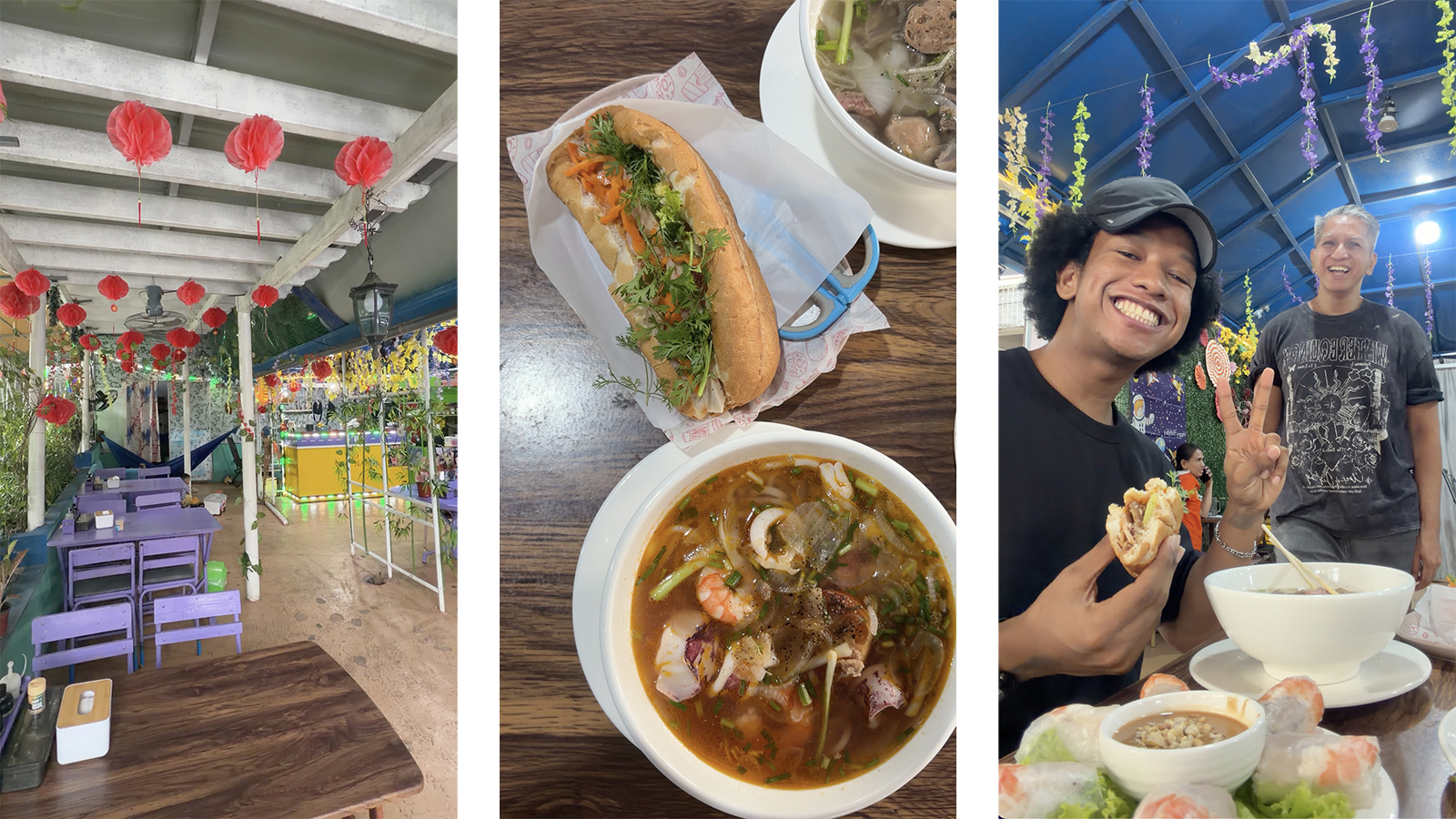
If you’ve been to Vietnam, you’d know that some of the best places to eat at are in those neighborhood eateries; their versions of karinderya, in a manner of speaking, where locals prep good lutong-bahay Vietnamese offerings sans the classy places of expensive restos. Here, the focus is always the food, never the blings.
So when we came across Facebook posts on Pho Viet Nam, located somewhere in San Pablo City in the Province of Laguna, we sort of expected to encounter what was experienced in Vietnam.
@outragemag Looking for #Vietnam food while in #SanPabloCity in #Laguna? We #LGBT checked #PhoVietNam ♬ original sound – Outrage Magazine
Una, this is not the most accessible place even for those with vehicles from Metro Manila. This is because you still have to travel for over an hour (if you’re lucky traffic-wise), and spend on your gas and the toll and so on.
Note that when you’re also along Apolinario Mabini Street, the resto isn’t apparent. It is located at the back of another resto (Joy), so it is very easy to miss. There is, BTW, a small entry at the side of the resto, which leads to an outdoor parking space.
Ikalawa, the actual resto is cheap-looking – e.g. plastic décor, running lights here and there, and so on. Very karinderya; cheap karinderya, for that matter.
Ikatlo, the servers were okay naman; they knew what was on the menu, and – after making quick recommendations – kept you undisturbed to enjoy what you ordered. The orders took some time to be prepped, however; I was even able to order bad-tasting fries from the other resto due to the waiting time.
Ika-apat, how was the food?
Both the ₱245 Beef Noodle Soup and the ₱245 Seafood Noodle Soup weren’t bad naman; but they weren’t good either. You get enough properly-cooked meats, the noodles are sufficient, and so on. Taste-wise, though, they were bland, and no amount of the prepared condiments helped in changing the flavor.
The ₱190 Rice Paper Roll sufficed even if, by and large, it was tasteless. The saving grace: the satay dip since it was rich and nutty and all that.
The ₱160 Meatloaf and Egg Sandwich (the banh mi kep thit va trung) had enough meat naman… and yet was also bland.
Considering the asking prices of this place, you sort of expect a lot, too. Add to that the popularity of the place – e.g. look at all those who dine there, kinukuyog. Alas, the realities when already there are harsher.
Heading to San Pablo to check this place led us to the nearby Dagatan Blvd. surrounding Sampaloc Lake, a must-check place in these parts. So we sort of do not regret heading to San Pablo.
But buod: No, Pho Viet Nam is not worth the dayo; not worth for you to intentionally seek this place out. The food wasn’t bad. But it’s not great, or even good either. It just suffices. And so, particularly for non-locals, the additional expenses for the gas, toll, et cetera make going there not worth it… sorry.
But off we go for more LGBTQIA+ rampa…
Pho Viet Nam is located at 130 Apolinario Mabini Street, San Pablo City, 4000 Laguna.

Checking Aling Lucing, where sisig was invented

Satisfying you craving for unli chicken in Pasig City

Stress more strongly linked to poorer quality of life among adults with multiple chronic conditions

Neighborhood ties and social connections are linked to high recycling participation

Going to the park at least once a week can improve children’s mental health

A longevity diet is not just about eating less—it is what, when, and for whom

Dance training influences how the brain processes facial emotions

Study reveals how gut antibodies protect against colon cancer

Jolting awake often is associated with poorer sleep and higher anxiety, survey finds

Curiosity and fearlessness apparent in German Shepherd genes

Can pistachios support sleep? Here’s what a new scientific review found

Dogs and owners disturb each other in the night, but still get pretty good sleep

For weight loss, where food comes from may matter as much as how it is processed
Curiosity and fearlessness apparent in German Shepherd genes

Mindfulness and self-compassion can alleviate premenstrual symptoms

Music can enhance the flavor of your food

Epigenetic clocks reveal why larger dogs age faster
Study reveals how gut antibodies protect against colon cancer
A longevity diet is not just about eating less—it is what, when, and for whom
Stress more strongly linked to poorer quality of life among adults with multiple chronic conditions

-
 Nutrition4 weeks ago
Can pistachios support sleep? Here’s what a new scientific review found
-
 Pet Care4 weeks ago
Dogs and owners disturb each other in the night, but still get pretty good sleep
-
 NewsMakers4 weeks ago
For weight loss, where food comes from may matter as much as how it is processed
-
 Pet Care2 weeks ago
Curiosity and fearlessness apparent in German Shepherd genes
-
 NewsMakers4 weeks ago
Mindfulness and self-compassion can alleviate premenstrual symptoms
-
 NewsMakers4 weeks ago
Music can enhance the flavor of your food
-
 Pet Care4 weeks ago
Epigenetic clocks reveal why larger dogs age faster
-
 NewsMakers2 weeks ago
Study reveals how gut antibodies protect against colon cancer